My Two Android Apps, Three Months Lost, and Why I Built onTest
I shipped two Android apps with over 40,000 combined downloads. But publishing each one took longer than building it. Here's the story of why I built onTest.
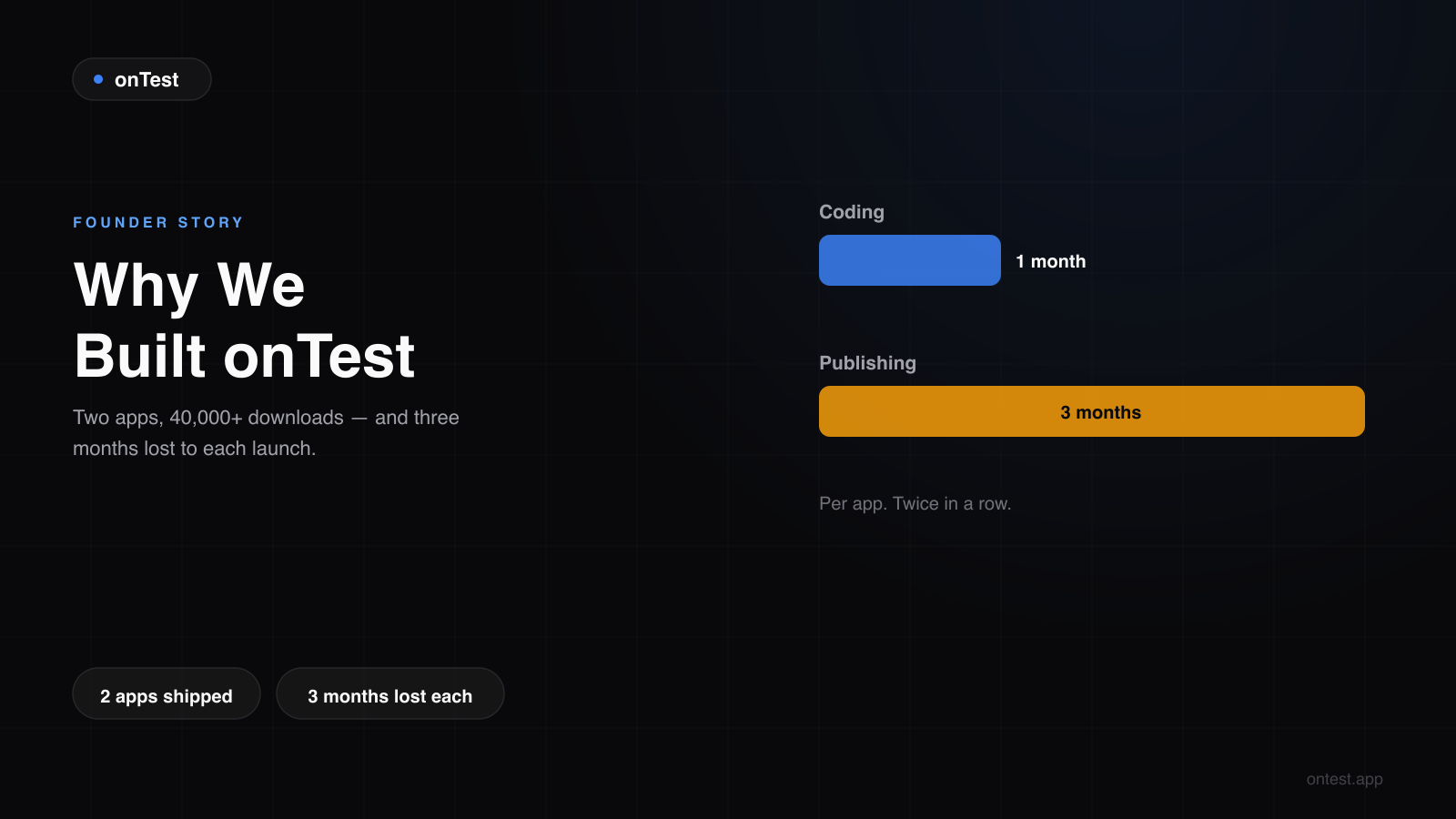
I have two apps on the Play Store.
The first is Motion Cues — an app that prevents motion sickness by syncing visual cues with your inner ear. Over 30,000 downloads.
The second is Let it Rain — a rain overlay app for relaxation and focus. Climbing toward 10,000.
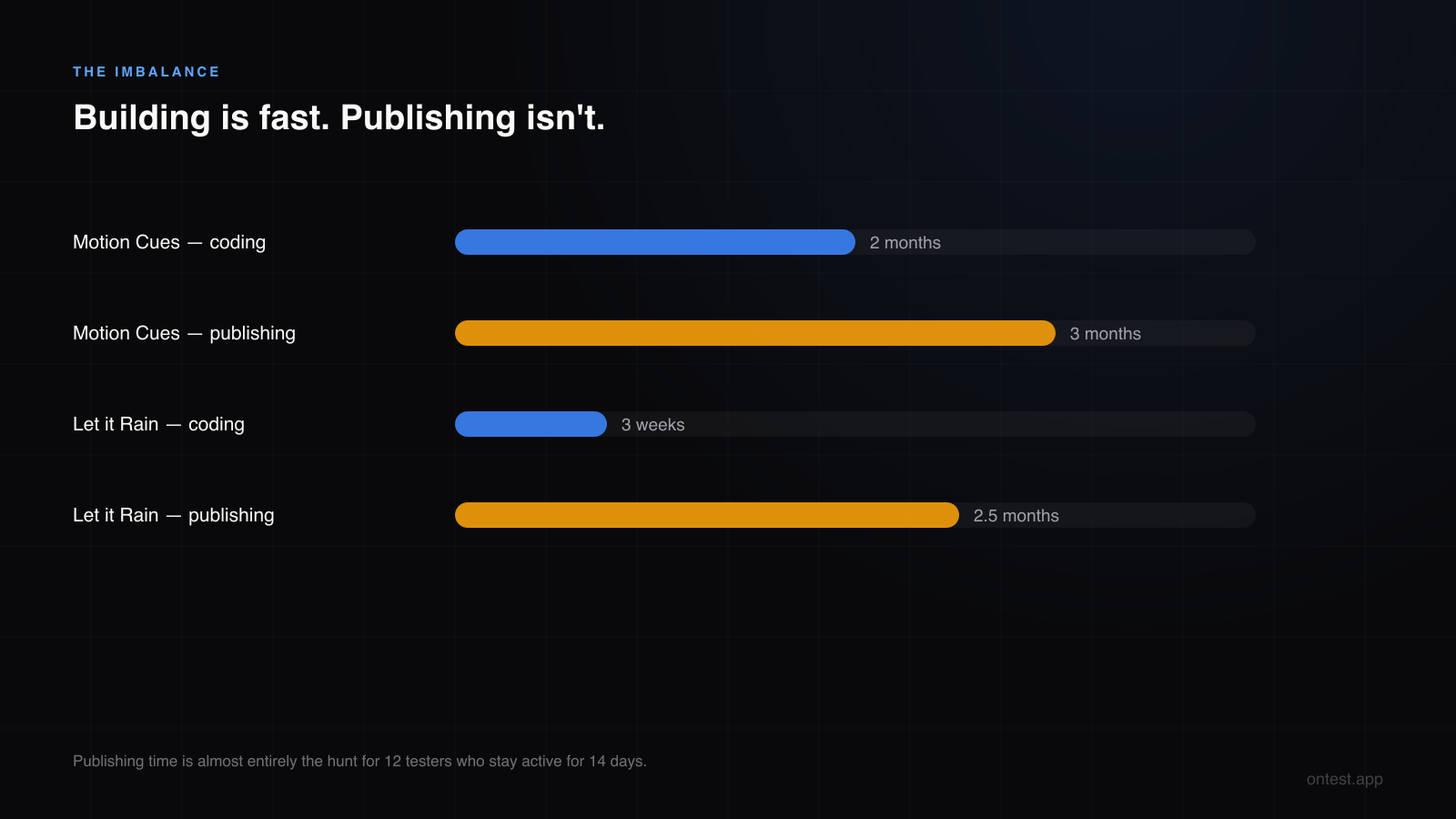
Each took about a month to code.
Each took three months to publish.
This is the story of how those six months were spent, and why they turned into a product idea.
Google Play's "Innocent" Rule
On November 13, 2023, Google Play added a requirement for new personal developer accounts:
Before your app can go to production, 12 testers must opt into your closed testing track and remain active for 14 consecutive days.
(If you want the full anatomy of this rule — who it applies to, who's exempt, how the 14-day clock behaves — I later wrote a complete breakdown of the 12 testers 14 days requirement.)
My account was created after that date. When I first read the rule, I thought: easy.
12 people. 14 days. How hard could it be?
Very hard. As it turned out.
Motion Cues — The First Wave
I started writing Motion Cues in early 2025. I have motion sickness myself, so I built a tool I'd personally use.
The idea was simple and grounded in science: use your phone's motion sensors to draw a subtle visual indicator on screen, helping your brain reconcile what your eyes see with what your inner ear feels. A motion sickness cure without pills.
The code took two months. Play Console listing, screenshots, description — one week.
Then came the publishing process.
The first thing I saw when I opened Play Console:
"New personal developer accounts must complete closed testing with 12 testers for 14 consecutive days before production access."
I laughed. "Okay, I'll find 12 people. Done."
"Just Ask Your WhatsApp Group"
I live in Istanbul. My circle is full of developers. I have thousands of connections on LinkedIn, many of them Android devs.
I went through every group I was in:
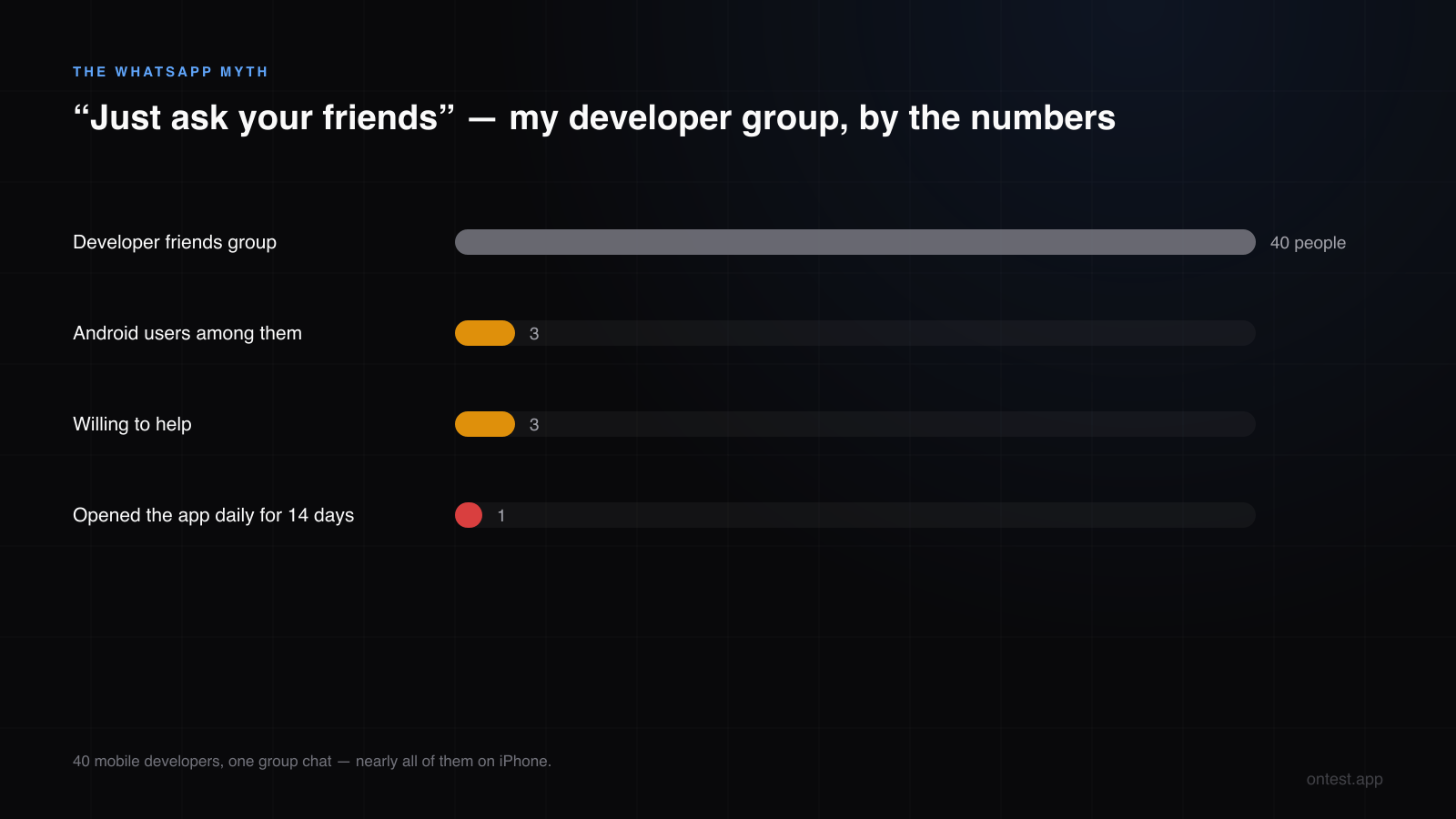
Developer friends group (~40 people):
- Android users: 3
- Willing to help: 3
- Actually opened the app daily for 14 days: 1
40 developers in one group. All on iPhone. It's 2026, and that's the irony — developers who build mobile apps are the least likely to actually use the OS their target users are on.
Family and extended circle:
- Android users: 7-8
- Explaining "open this every day for two weeks": exhausting
- Forgot by day 3: most of them
University WhatsApp group (~100 people):
- Slightly more Android users, but every opt-in came with questions: "What is this? Is it safe? Why do I have to open it every day? How many days?"
End of week one: 5 active testers. 7 short. The 14-day clock threatened to reset every day.
I Turned to Fiverr
This is what everyone does. Out of necessity.
You've probably seen the gigs: "12 Testers for Google Play — $15." I messaged one and paid.
Two days later, a list of 12 Gmail addresses arrived. I added them to Play Console. Waited.
Two people opted in.
I messaged the Fiverr seller. "Did you share the opt-in link with them?" Yes, the seller said. "They forget sometimes, I'll remind them." The seller reminded them. Five more opted in. Total: 7.
But was anyone actually using the app? No.
The emails looked real, but there was no real behavior: the app wasn't being opened daily, wasn't running on diverse Android devices, wasn't generating the engagement patterns Google Play's algorithm looks for. And Google Play's algorithm, as it turned out, is smart enough to notice.
What the Fiverr seller was really selling was email delivery, not testing. Whether those emails corresponded to real people who used your app daily was not their problem.
Reddit Swap Threads
I ended up in r/androiddev's closed testing swap threads.
Here's how they work: You test someone else's app for 14 days, and in return, they test yours.
The math is brutal: you need to test 12 apps, each for 14 days. That's opening 12 different apps every single day for two straight weeks. Just to launch your own.
I did three swaps. For two weeks, I opened three random strangers' apps every day. Then one dropped out. Their swap partner dropped out too. Domino.
By week three, I was still bouncing between 10-11 active testers. Never hit 12 continuously.
(Friends, Reddit, Fiverr, Discord, tester exchanges — I eventually compared every way to get 12 testers, with honest numbers for each. I wish that comparison had existed when I was living it.)
Three Months Later
January: code finished. April: production access granted.
- Coding: 2 months
- Launch preparation: 1 week
- Finding 12 testers: 3 months
Motion Cues is now on the Play Store with 30k+ downloads. Average rating above 4 stars.
But those three months — they stayed with me.
Let it Rain — The Pattern Repeats
A few months later, I started my second app: Let it Rain. A screen overlay that shows rain effects and plays ambient sounds for relaxation and focus.
This time the code was faster — maybe three weeks. I'd learned from Motion Cues, the second project always is.
But the publishing process started from scratch.
12 testers. 14 days. Again.
A month into the second launch I caught myself thinking: if I could just move Motion Cues testers to Let it Rain, I'd be saved. But Google wants fresh testing for every new app.
Every new app = 12 testers from zero = 14 more days of waiting.
I messaged the same WhatsApp groups again. Struggled with the same Fiverr freelancers. Bounced through the same Reddit swap threads.
Let it Rain eventually went live. Time to production: 2.5 months.
This Is Where It Clicked
That night I sat down and did the math. This wasn't a bug. This was a system.
After going through it twice — and spending hours researching other developers going through the same thing — I realized:
This isn't unique to me. On Reddit, Twitter, LinkedIn, every day, hundreds of developers are in the same hole. Every month, thousands.
- "Who needs testers? DM me for swap"
- "Lost $50 on Fiverr tester scam"
- "Launch delayed 6 weeks, still stuck on closed testing"
- "Google why is this so hard"
Every single one hitting the same 12-tester wall.
The Vibe Coding Era Made Shipping Harder Than Building
Something shifted in 2025-2026: writing code became accessible to everyone.
- Claude Code, Cursor, Bolt, Replit
- Working apps built over a weekend
- Non-developers shipping mobile apps
- "Vibe coding" — not writing code, describing outcomes
Building a mobile app now takes days.
Publishing one still takes months.
Google Play's closed testing rule was well-intentioned: filter out low-quality apps. In practice, it became an impossible barrier for indie and solo developers.
And that barrier isn't ready for the wave of vibe-coded apps about to hit it. In the next 12 months, tens of thousands of new indie developers will enter the Play Console queue. Every one of them will hit the same 12-tester wall. The same Fiverr scams. The same Reddit swap loops. The same three months lost.
So We Made a Service
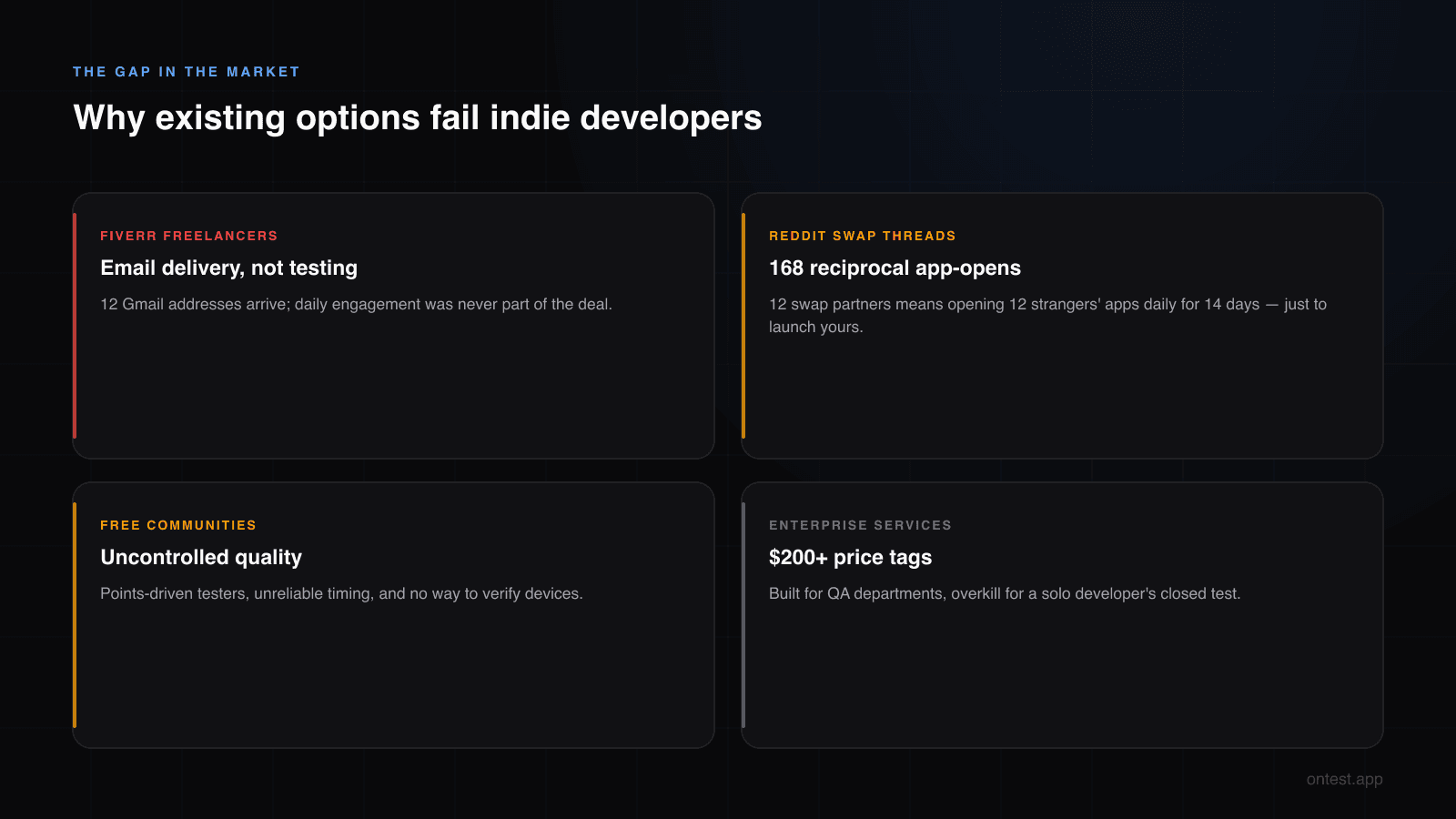
Existing solutions weren't built for this wave:
- Fiverr freelancers: They sell email delivery, not engagement.
- Reddit swap threads: Force you into 14 days of testing strangers' apps.
- Free tester communities: Quality is uncontrolled, timing unreliable.
- Enterprise testing services: $200+ price tag, overkill for indies.
There was a gap in the middle — a real product was missing:
- Real Android devices (not emulators, not throwaway accounts)
- Real user behavior (opt-in + daily engagement)
- 14-day continuous engagement guaranteed
- Transparent dashboard
- A process indie developers could trust
- Indie-friendly pricing
That's where onTest came in.
How onTest Works
Real tester network. No fake Gmail accounts. Real people, on real Android devices, with real usage patterns.
14-day continuous engagement, guaranteed. No disappearing on day 5. Our testers stay active for the full 14 days.
One flat package. 12 devices, 15 days (the 14 Google requires plus 1 bonus day): $19.99. Backed by a 3-day unconditional money-back guarantee.
Live dashboard. See the activation and usage status of every device in real time. No "what's happening?" anxiety.
Built for vibe coders. No technical jargon. Get the email list, paste it into Play Console, testing starts. That's it.
If you've already got your 12 testers active and you're about to fill the production access form, we also wrote a step-by-step guide for that: Production Access Questionnaire: The 10 Questions Answered. And if you're still planning your launch, the real end-to-end timeline is here — budget accordingly.
A Note to Developers Reading This
If you're stuck in closed testing right now — welcome, you're not alone.
Every month, thousands of indie developers are in the same hole. I went through it twice. Thousands of developers on Reddit are going through it right now.
But there's a way out of this story.
onTest exists to save you three months.
Instead of going to production after 90 days, you go after 14.
Related guides
- Google Play's 12 Testers 14 Days Requirement Explained — The rule that started all of this, clause by clause.
- How to Get 12 Testers: 7 Methods Compared — Everything I tried, plus the methods I didn't know about.
- How Long Does Google Play Closed Testing Actually Take? — The real timeline behind my "three months lost."
- Closed Testing Rejected? 5 Reasons Why — For when the process fights back.
If you've been through something similar, I'd love to hear your story. Reach out at hello@ontest.app — even two lines is fine.
And good luck with your launch. You'll get there.
Ready to ship your Android app?
Get 12 real testers for Google Play Closed Testing in 14 days.
Get Started