How to Get 12 Testers for Google Play Closed Testing: 7 Methods Compared (2026)
You need 12 testers for 14 days before Google lets you publish. Here are all 7 ways to find them — friends, Reddit swaps, Discord, Fiverr, tester exchanges, communities, and paid services — compared honestly by cost, speed, and rejection risk.
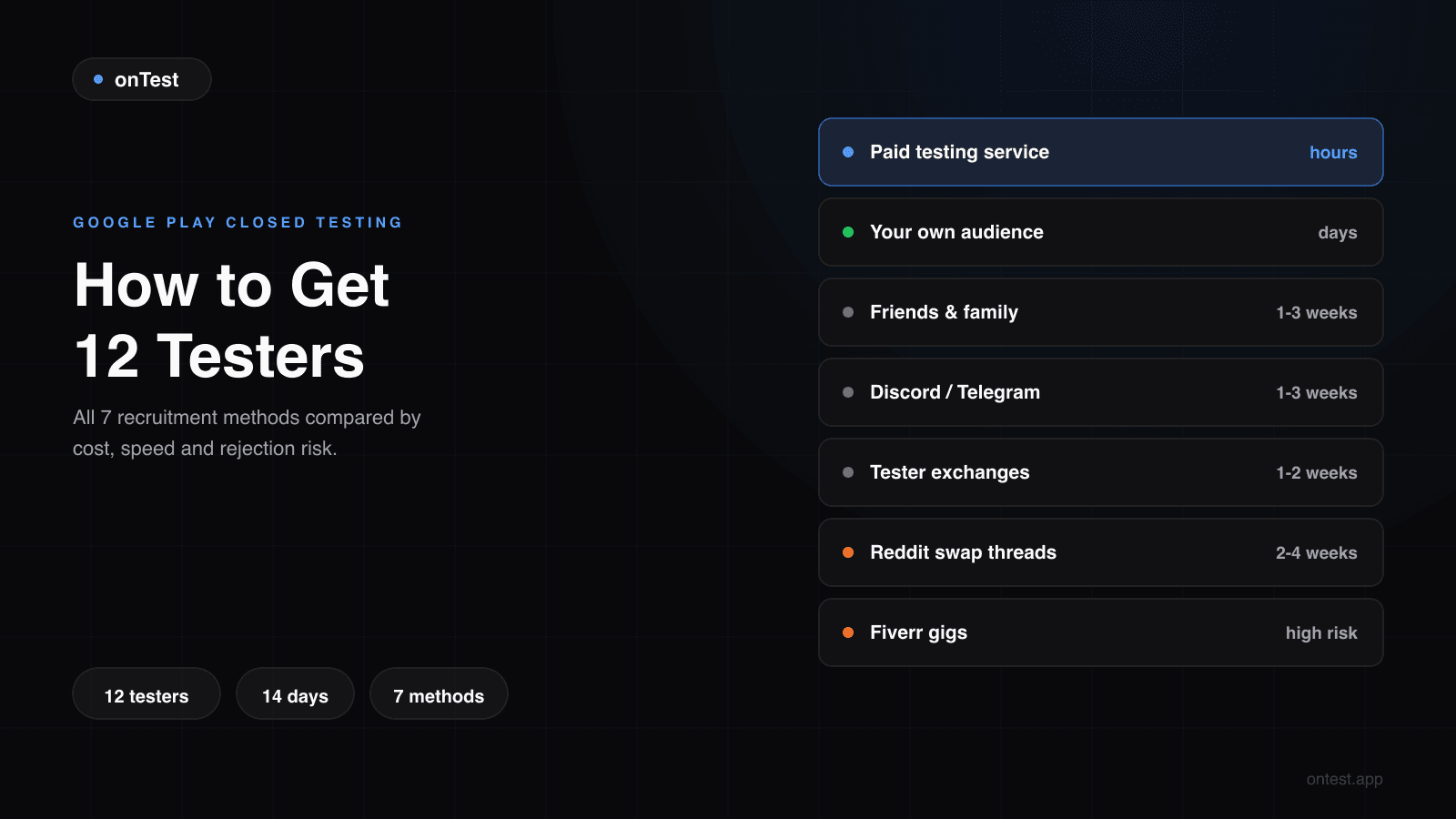
TL;DR: There are exactly seven ways to get 12 testers for Google Play closed testing: your personal network, Reddit swap threads, Discord/Telegram communities, Fiverr gigs, free tester exchange platforms, your own audience, and paid testing services. I tried five of them across two app launches. This post compares all seven by cost, time-to-12, engagement reliability, and rejection risk — so you can pick based on your actual situation instead of trial and error.
If you're reading this, you've probably just seen the message in Play Console: your app can't go to production until 12 testers stay opted in to your closed test for 14 consecutive days.
Twelve people. Sounds trivial. It isn't.
I shipped two apps through this requirement — Motion Cues took 6 weeks to find 12 stable testers, Let it Rain took 3 weeks even after I'd learned the lessons. Finding testers is the phase that decides your entire timeline: everything else in the process is fixed-duration.
Here's every method that exists, with honest numbers.
First, Understand What "12 Testers" Actually Means
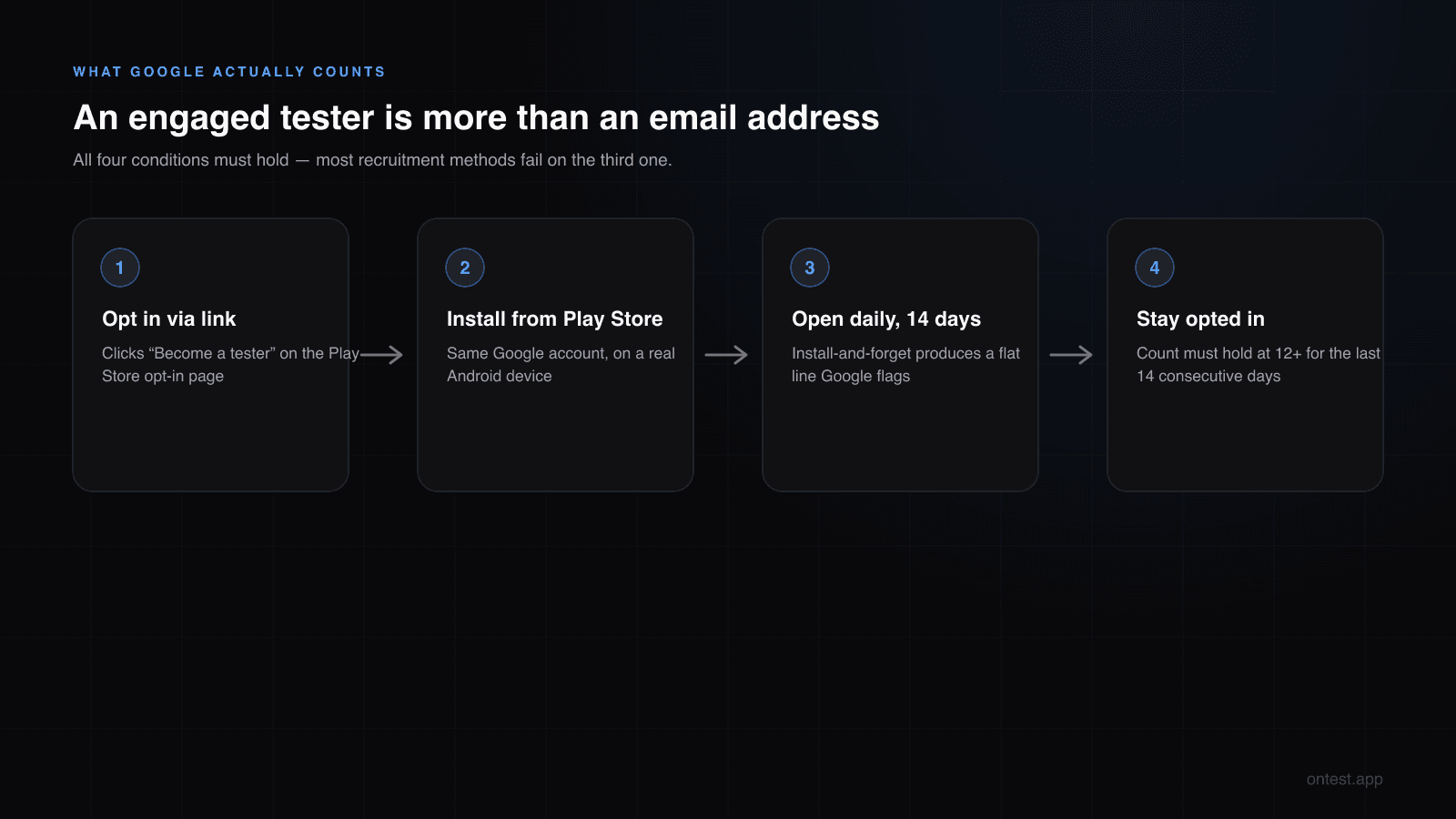
Before recruiting anyone, know what you're recruiting for. Google doesn't count email addresses — it counts engaged testers on real devices:
- They must click the opt-in link and install from the Play Store
- They must open the app regularly across all 14 days — install-and-forget gets flagged
- They must be on real Android devices — emulators fail Play Integrity checks
- The count must stay at 12+ for the last 14 consecutive days when you apply
This matters because most recruitment methods fail on point two. Getting 12 opt-ins is easy. Getting 12 people to open your app every day for two weeks is the actual problem — opt-in, install, and daily usage are three different levels, and Google evaluates the third. If your testers exist on paper but never use the app, you'll get rejected — I wrote a full breakdown of why closed tests get rejected even with 12 opted-in testers.
Now, the seven methods.
Method 1: Friends, Family, and Your Personal Network
Time to 12 testers: 1-3 weeks. Cost: free (in money). Engagement reliability: low-medium.
The first thing everyone tries. Here's my actual data from Motion Cues:
- Developer friends group, ~40 people: 3 Android users. Most developers use iPhones — the irony of the decade.
- Family and extended circle: 7-8 Android users, but explaining "open this app every day for two weeks" to your aunt is a part-time job.
- University WhatsApp group, ~100 people: a few more Android users, each opt-in preceded by five questions ("Is this safe? Why every day?").
End of week one: 5 active testers. And engagement decays fast — most of my family testers forgot by day 3, so the 14 days became a daily reminder campaign.
Use this method for: 3-5 of your 12, not all 12. Real friends who genuinely use your app also give the best feedback for the production access questionnaire.
Avoid if: your circle is mostly iPhone users. Check this before you plan around it.
Method 2: Reddit Tester Swap Threads
Time to 12 testers: 2-4 weeks. Cost: free in money, enormous in time. Engagement reliability: medium, fragile.
r/androiddev and dedicated testing subreddits run swap threads: you test someone's app for 14 days, they test yours.
The math nobody does before starting: 12 swap partners means you open 12 strangers' apps every day for 14 days — 168 app-opens of other people's work, just to launch yours. And the domino problem is real: I did three swaps for Motion Cues, one partner dropped out, their partner dropped out, and my active count fell below 12 again.
Two more risks:
- Posting in the wrong place gets you banned. Some subs only allow tester requests in the dedicated thread. Nobody warns you until it's too late.
- Swap engagement is begrudging. A partner opening your app for 3 seconds daily produces a barely-there engagement signal — Google notices the difference between usage and box-ticking, as I explained in why real human testers matter.
Use this method for: 2-4 testers if you have more time than money and genuinely don't mind testing other apps.
Avoid if: you're on a deadline, or you can't commit to 14 days of daily reciprocal testing.
Method 3: Discord and Telegram Testing Communities
Time to 12 testers: 1-3 weeks. Cost: free. Engagement reliability: medium.
Several Discord servers and Telegram groups exist specifically for closed testing exchanges. They work like Reddit swaps but with faster communication — you can actually ping someone who's gone quiet.
The quality varies wildly by server. Good ones have reputation systems and active moderation. Bad ones are full of people who join, get their 12 testers, and vanish without honoring their side.
Use this method for: supplementing other channels. The real-time chat makes coordinating drop-off replacements easier than Reddit.
Avoid if: you can't verify the community is active. A dead server costs you a week of waiting to find that out.
Method 4: Fiverr Gigs ("12 Testers for $15")
Time to 12 testers: allegedly 2-3 days. Cost: $10-25, often wasted. Engagement reliability: very low.
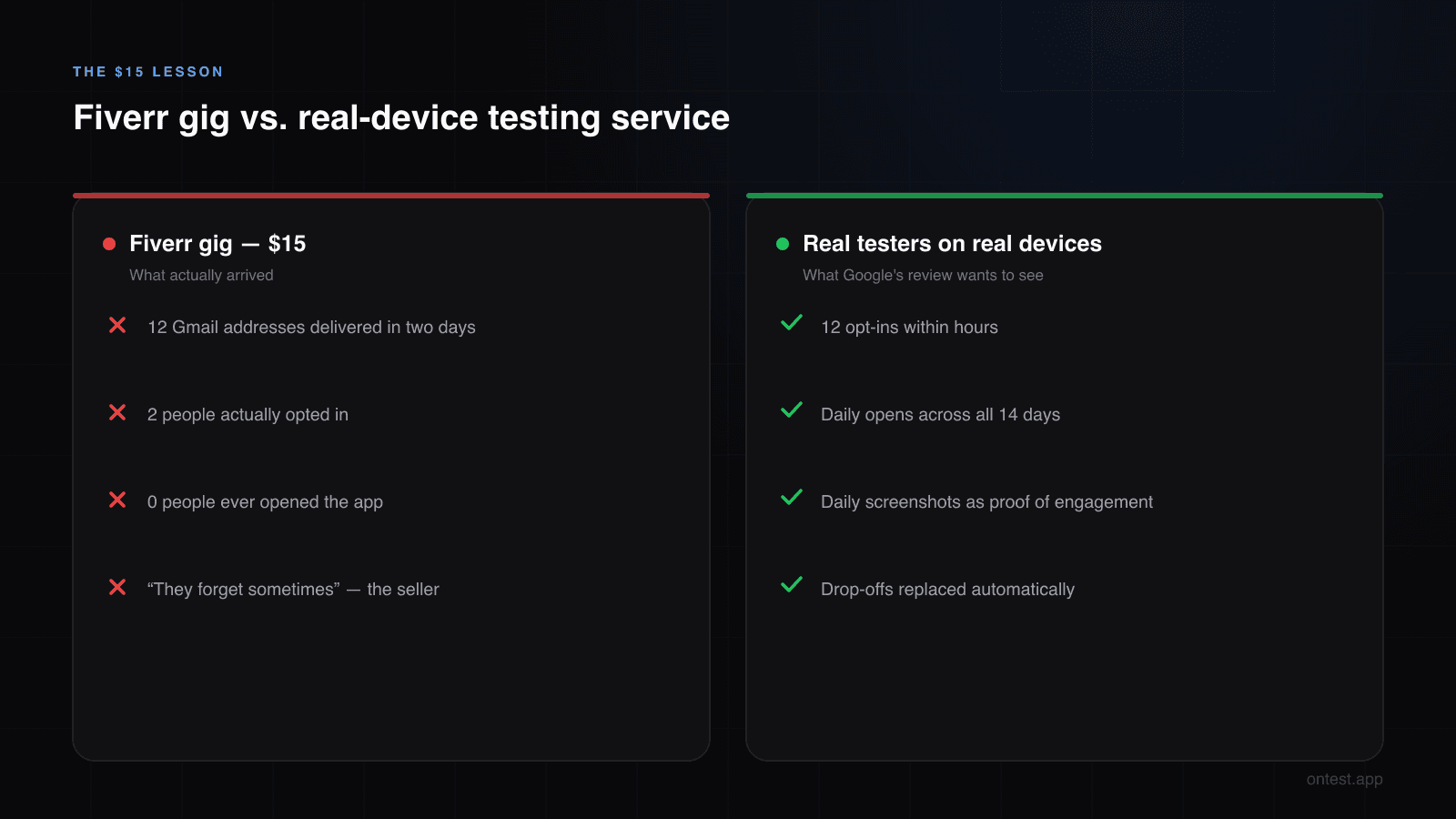
You've seen the gigs. I paid $15 for one during Motion Cues. Here's what I got:
- 12 Gmail addresses delivered in two days
- 2 people actually opted in
- 0 people opened the app
When I messaged the seller, the answer was "they forget sometimes." The seller was selling email delivery, not testing — whether real humans engaged with my app daily was never part of the deal.
This gets worse every year. Google's engagement detection in 2026 flags exactly this pattern: opt-ins with zero sessions. Many Fiverr operations also run emulator farms or batch opt-ins from the same network — both are detection triggers that can flag your entire test as "irregular testing activity."
Use this method for: honestly, nothing. The success stories are outnumbered by the horror stories.
Avoid if: you value the $15, or the two weeks you'll lose discovering it didn't work.
Method 5: Free Tester Exchange Platforms
Time to 12 testers: 1-2 weeks. Cost: free + your testing time. Engagement reliability: medium.
A few web platforms formalize the swap model: you earn points by testing other apps, spend points to get testers for yours. Better than raw Reddit swaps because the platform tracks who's actually testing.
The catch is the same economics as swaps — testers are there to earn points, not because they care about your app. Sessions are short, feedback is thin, and when their point goal is met, engagement drops. The platforms also can't verify device quality, so you don't know if your "testers" are on five-year-old budget phones or emulators.
Use this method for: filling 3-5 slots if you have time to earn points before your launch window.
Avoid if: you need consistent 14-day engagement — points-driven testers are the classic source of the day-2 engagement cliff.
Method 6: Your Own Audience
Time to 12 testers: days (if you have one). Cost: free. Engagement reliability: high.
If you have a newsletter, a Twitter/X following, a YouTube channel, or an existing app's user base — this is the best free method that exists. People who already care about what you build make genuinely engaged testers.
The obvious problem: most first-time developers don't have an audience. That's precisely why they're hitting this wall. If you're launching your second or third app, cross-promote: an in-app banner in your live app recruiting testers for the new one works remarkably well.
Use this method for: everything it can cover, if you have the audience.
Avoid if: N/A — there's no downside except not having an audience yet.
Method 7: Paid Testing Services
Time to 12 testers: hours. Cost: $15-30. Engagement reliability: high (if the service is real).
Paid services maintain networks of real testers who opt in, install, and use your app daily for the full 14 days. This is the method that converts the recruitment phase from weeks to hours — which is why the total timeline drops from 60-90 days to about 3 weeks when Phase 2 is solved.
The critical distinction is real devices and real engagement vs. bulk opt-ins. Questions to ask any service before paying:
- Which specific device models? ("Samsung, Xiaomi and more" is not an answer)
- How do you prove daily engagement? (Dashboards and screenshots vs. "trust us")
- What happens when a tester drops off? (Replacement protocol vs. your problem)
- Is it Google-compliant? (Yes — Google's own questionnaire lists paid services as a valid recruitment channel. Disclose it honestly; it's fine.)
Full disclosure: I built one of these services. onTest sells one flat package: 12 testers, 15 days (the 14 Google requires plus 1 bonus day), $19.99, with a 3-day money-back guarantee. Testers run Android 14+ devices (Galaxy S24, Pixel 8, Xiaomi Mi 14, Nothing Phone 2, OnePlus 12 and more), and you get daily screenshots from every device as proof of engagement. I built it because methods 1-5 cost me three months across two apps. If you want the detailed comparison against other testing services, that's a separate post.
Use this method for: covering the whole requirement in one order, no recruitment at all.
Avoid if: your budget is genuinely zero — then combine methods 1, 2, and 3 and budget 4-8 weeks.
The Comparison Table
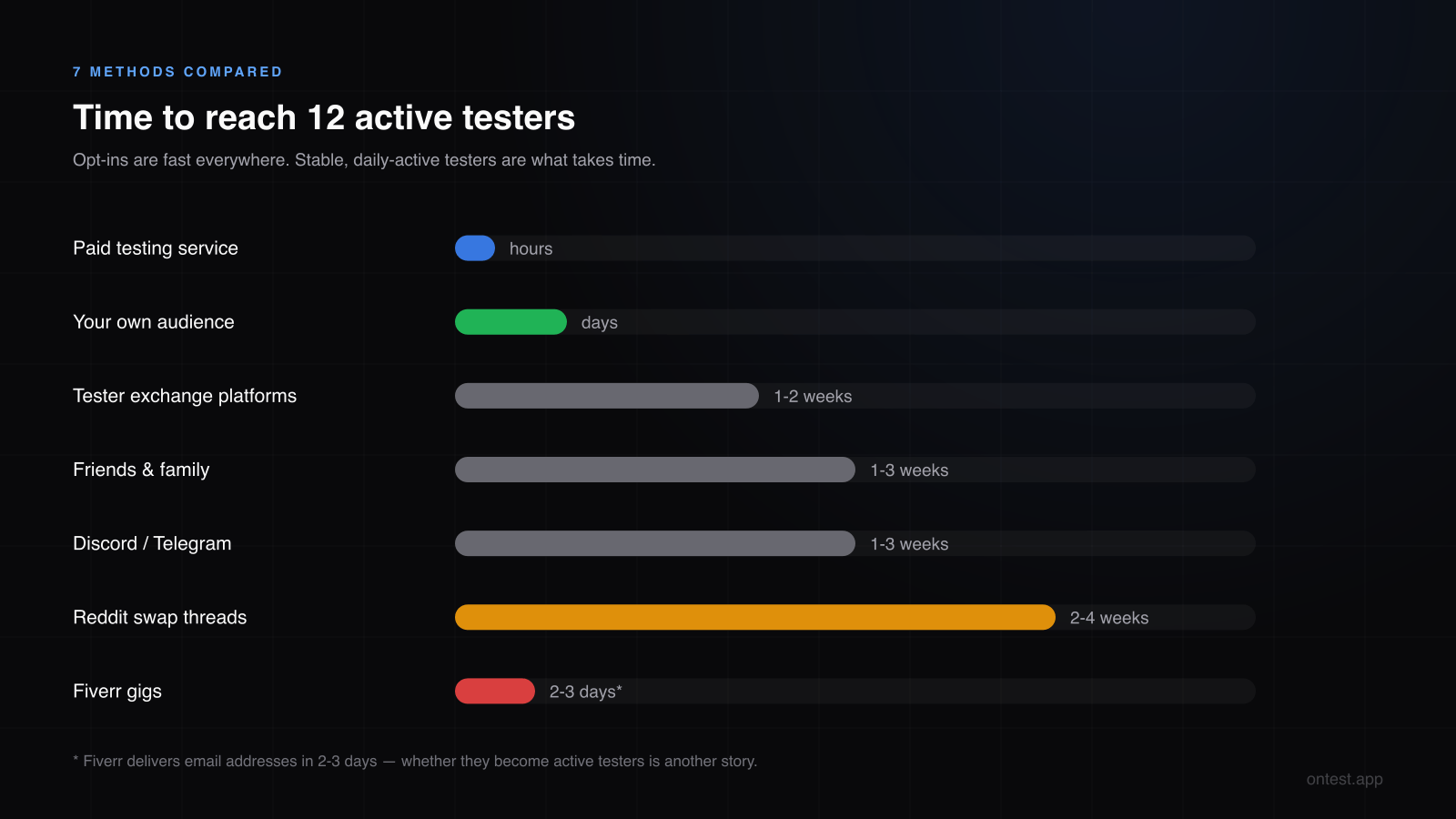
| Method | Time to 12 | Money cost | Time cost | Engagement | Rejection risk |
|---|---|---|---|---|---|
| Friends & family | 1-3 weeks | Free | Medium (reminders) | Low-medium | Medium |
| Reddit swaps | 2-4 weeks | Free | Very high (168 reciprocal opens) | Medium | Medium |
| Discord/Telegram | 1-3 weeks | Free | High | Medium | Medium |
| Fiverr gigs | 2-3 days* | $10-25 | Low | Very low | High |
| Tester exchanges | 1-2 weeks | Free | High | Medium | Medium |
| Your own audience | Days | Free | Low | High | Low |
| Paid service (real devices) | Hours | $15-30 | Low | High | Low |
*Fiverr delivers emails in 2-3 days; whether they become active testers is another story.
The Strategy That Actually Works: Combine and Over-Recruit
Whatever mix you choose, three rules apply universally:
1. Recruit 15-18, not 12. Drop-offs are inevitable — someone changes phones, goes on vacation, forgets. A buffer means one dropout on day 9 doesn't put your whole timeline at risk. Google doesn't cap tester count.
2. Start before your code is done. When the build is ~80% complete, start recruiting. Finding testers takes days to weeks; let it run in parallel with polish. This single habit would have saved me a month on Motion Cues.
3. Track engagement from day 1. Don't discover on day 13 that four testers went silent on day 4. Check Play Console's testing metrics every day or two, and replace flat-lining testers immediately.
Which Method Should You Pick?
- Zero budget, flexible timeline (4-8 weeks OK): friends + Reddit swaps + Discord. Over-recruit to 16+. The free vs paid breakdown prices each free channel in hours.
- Zero budget, existing audience: your audience + friends. Fastest free path.
- Small budget ($20-30), want it done this week: paid service with verified real devices. Skip Fiverr entirely — same money, opposite outcome.
- Already burned by a rejection: paid service + read the rejection recovery guide before you resubmit. Repeating the same tester setup produces the same result.
Frequently Asked Questions
How many testers do I need for Google Play closed testing?
A minimum of 12 testers must remain opted in to your closed testing track for 14 consecutive days before you can apply for production access. This applies to personal developer accounts created after November 13, 2023. Recruiting 15-18 is smarter — the buffer absorbs inevitable drop-offs. The full rule is explained in our 12 testers 14 days guide.
Can I use family members as testers for Google Play?
Yes. Google doesn't restrict who your testers are — any real person with a real Android device and a Google account counts. The practical challenge is engagement: family testers commonly forget to open the app daily, and inconsistent engagement is a leading cause of "more testing required" rejections.
Are paid testers allowed by Google Play?
Yes, explicitly. Google's production access questionnaire lists paid testing services as a valid recruitment channel. What Google evaluates is whether testing genuinely happened — real devices, real daily engagement — not which channel you used to find testers.
How fast can I realistically get 12 testers?
With a paid service: hours. With an existing audience: days. With friends, Reddit swaps, and Discord communities combined: typically 2-6 weeks to reach 12 stable, active testers. Getting 12 opt-ins is faster than getting 12 people who actually open the app daily.
Do Fiverr tester gigs work in 2026?
Rarely. Most sell email delivery, not engagement — testers opt in but never open the app, which Google's engagement detection flags. Emulator-based gigs trigger Play Integrity failures. The typical outcome is a rejection plus two lost weeks.
What happens if a tester drops out during the 14 days?
One dropout doesn't necessarily reset the clock, but the metrics show a warning and Google may require additional testing days. This is why over-recruiting to 15-18 matters. If your count drops below 12 for the final 14-day window, you cannot apply until it recovers for a full 14 consecutive days.
Do my 12 testers all need different devices?
They need real and reasonably diverse devices. Twelve identical budget phones on the same network look like a tester farm to Google's algorithm. A natural mix of brands, Android versions, and locations matches what a genuine user base looks like.
Can I reuse the same testers for my next app?
Yes — nothing prohibits it, and it's one of the best reasons to keep your tester relationships warm. Each new app still requires its own fresh 14-day closed test with 12 opted-in testers.
Related guides
- Android Developer Verification Is Live: Why the free 20-device limited distribution account is not a way to get your 12 testers.
- Google Play's 12 Testers 14 Days Requirement Explained — What the rule actually says, who it applies to, and how the 14-day clock works.
- How to Set Up Google Play Closed Testing: Step-by-Step — Get the track, countries, and opt-in link right before recruiting anyone.
- What Counts as an "Active" Tester? — Why 12 opt-ins and 12 active testers are different numbers.
- Free Testers vs Paid Testers — The free channels above, priced honestly in hours.
- How Long Does Google Play Closed Testing Actually Take? — The full timeline; finding testers is the phase that decides it.
- Closed Testing Rejected? 5 Reasons Why — What to do when 12 testers weren't enough.
- Production Access Questionnaire: 10 Questions Answered — The form you'll face after the 14 days.
- Why Real Human Testers on Real Devices Matter — How Google tells real testing from fake.
Stuck on recruiting right now? Email me at hello@ontest.app — I'll tell you honestly which method fits your situation, even if it's not mine.
Ready to ship your Android app?
Get 12 real testers for Google Play Closed Testing in 14 days.
Get Started