Google Play Closed Testing Review Time in 2026: How Long Does It Actually Take?
Google says 14 days. The real answer? 18-22 days minimum if everything goes right, 3+ months if it doesn't. Here's the phase-by-phase breakdown from someone who shipped two apps through it.
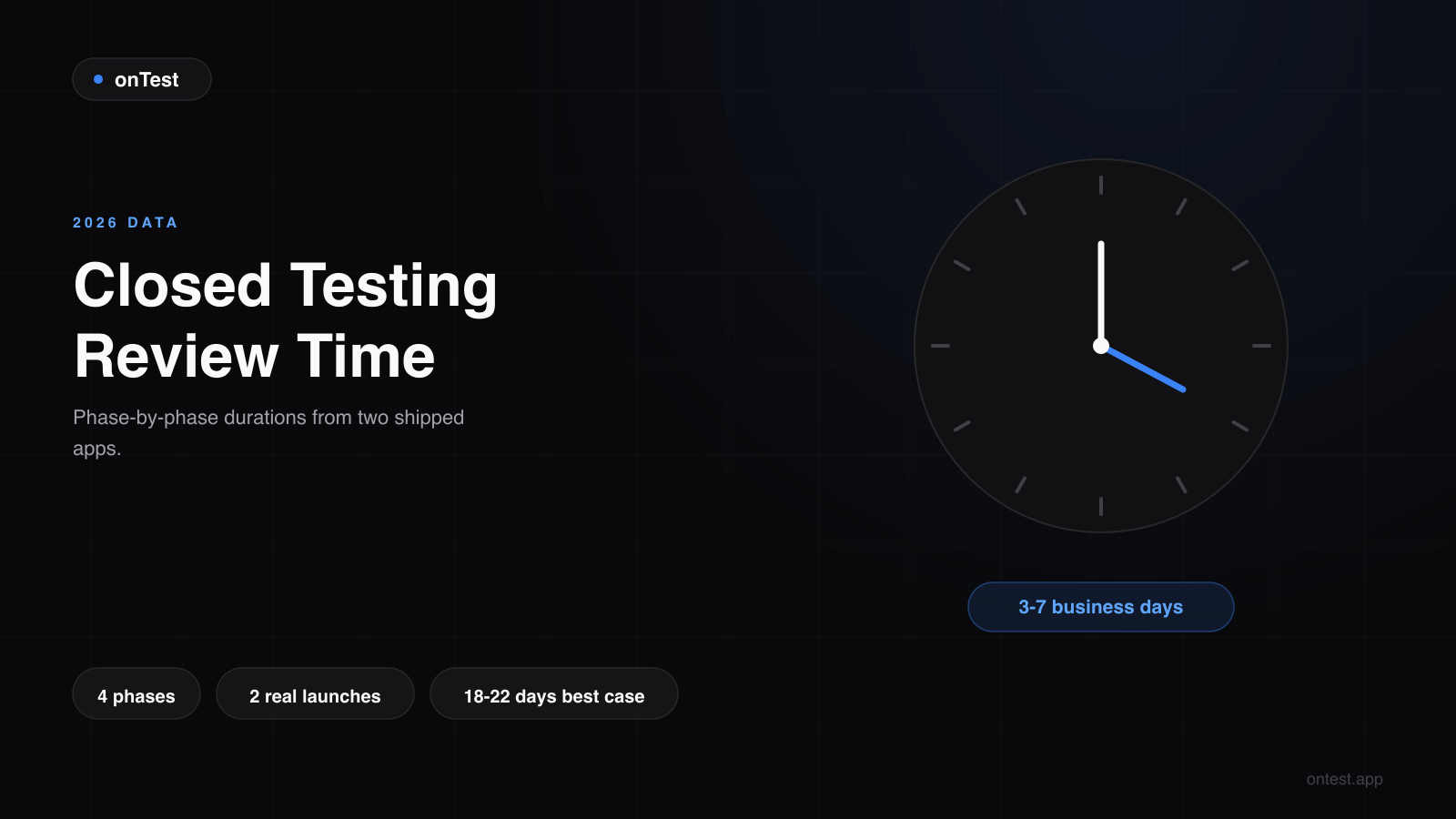
TL;DR: The Google Play closed testing review time in 2026 breaks down into four phases: internal testing setup (1-2 days), finding 12 testers (hours to months depending on your method), the 14-day active testing window, and the production access review (3-7 business days). I shipped two apps through this process — Motion Cues took roughly 3 months end-to-end, Let it Rain took about 2.5 months. Realistic total if you have testers ready: 18-22 days. Without them: 60-90+ days.
The Google Play Closed Testing Review Time Nobody Warns You About
Google's documentation says 14 days. That number is technically correct — it's the duration of the active closed testing window. But if you're a developer asking "how long does Google Play closed testing take in 2026," the real answer includes everything before and after those 14 days.
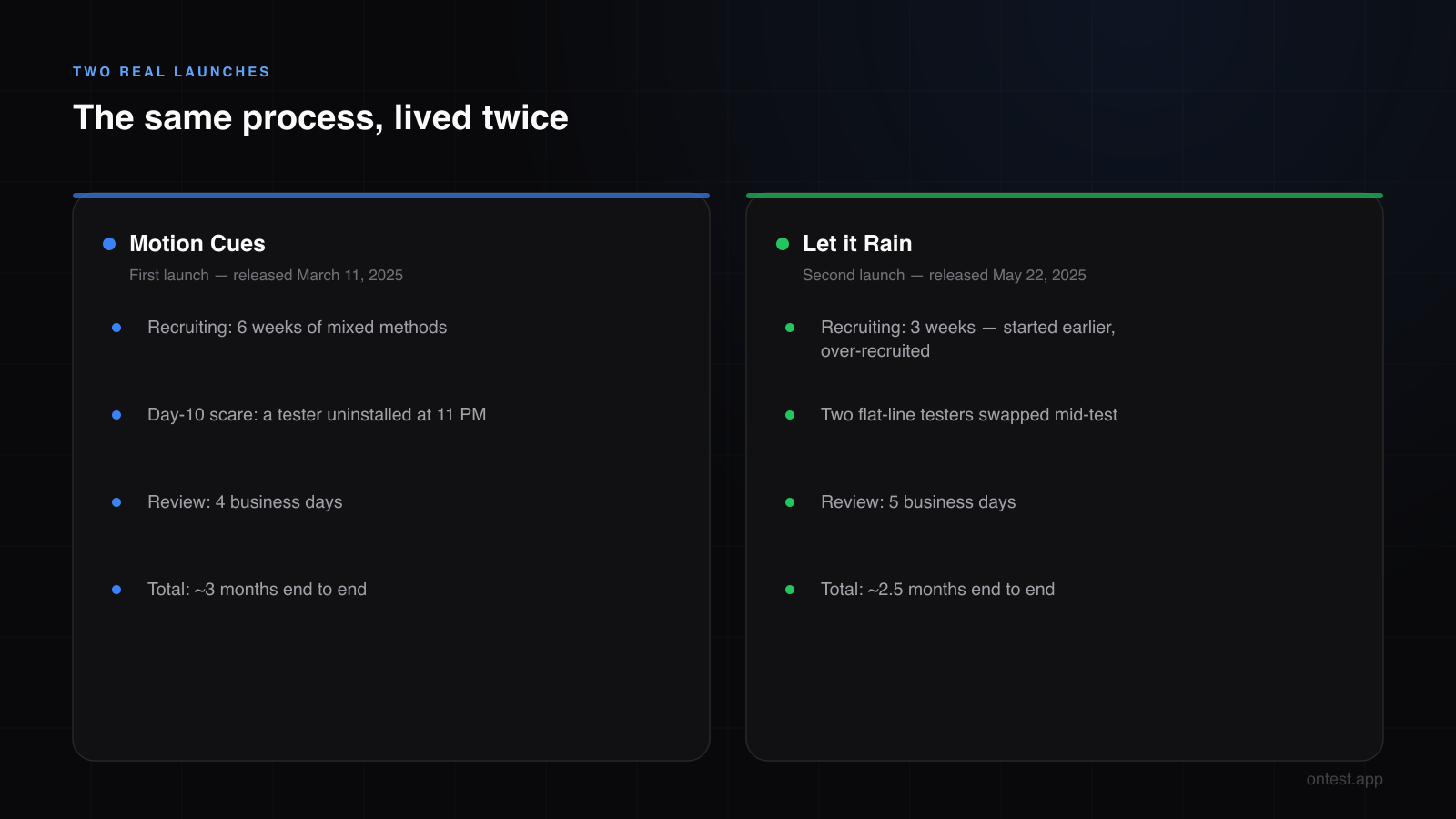
I know because I went through it twice. Once for Motion Cues (a motion sickness prevention app, released March 11, 2025) and once for Let it Rain (a rain overlay app for focus, released May 22, 2025). Combined, I lost about 5.5 months of productive time to this process.
Here's every phase, with the actual days I spent on each.
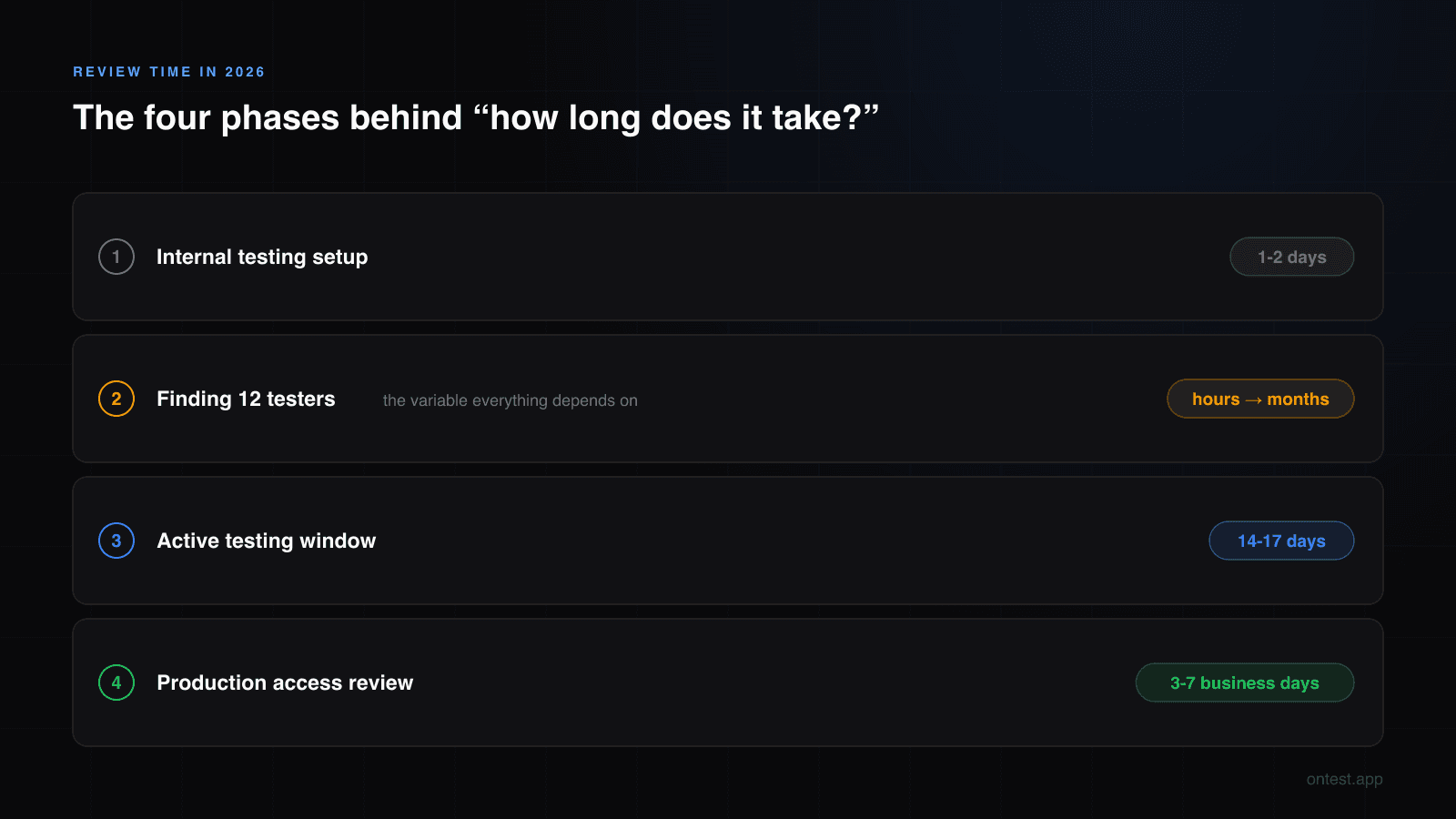
Phase 1: Internal Testing Setup (1-2 Days)
This is the easy part. Upload your AAB, fill out your store listing, complete the content rating questionnaire, configure the closed testing track. It takes a day or two of focused work.
For Motion Cues, I started this in late December 2024. The app was coded, tested locally, and ready. Setting up Play Console took me about a day — screenshots, descriptions, privacy policy, content rating. Nothing complicated, just tedious.
For Let it Rain, I did the same setup in February 2025. Faster the second time because I'd already been through the flow.
2026 note: Google has slightly reorganized the Play Console UI since I went through this. The testing track configuration and release management sections keep moving. If you can't find the closed testing setup, check under Release > Testing > Closed testing — though by the time you read this, it might have moved again. (The current click-by-click setup guide is here, kept up to date with the 2026 Console.)
One thing that hasn't changed: you still need a privacy policy URL before you can proceed. Don't skip this. A missing or broken privacy policy link is one of the most common reasons for delays later in the process.
Phase 2: Finding 12 Testers (The Phase That Breaks Timelines)
This is where the Google Play console closed testing review time balloons from "14 days" to "3 months."
Google's rule, introduced November 13, 2023 for new personal developer accounts: 12 testers must opt into your closed testing track and remain active for 14 consecutive days before you can apply for production access. If the count drops below 12, you get a warning — and if it stays low, your production access review takes longer or gets flagged. (The full anatomy of this rule — exemptions, clock behavior, common myths — is in the 12 testers 14 days requirement explained.)
For the general breakdown of what this phase involves, I wrote a detailed walkthrough in a separate post covering the full closed testing process — and if you're choosing a recruitment channel right now, all seven methods are compared here.
Here, I'll focus on what specifically ate my time.
Motion Cues: 6 Weeks to Get 12 Stable Testers
I started recruiting in early January 2025. My initial plan was simple: ask developer friends, family, and university contacts. I'm in Istanbul with a large professional network — thousands of LinkedIn connections, multiple WhatsApp groups.
The problem? Most developers use iPhones. My developer group of 40 people had exactly 3 Android users. Family members needed hand-holding through the opt-in process. University contacts asked too many questions and forgot by day 3.
I tried Fiverr. Paid $15. Got 12 email addresses. Two people actually opted in. None opened the app. The seller was selling email delivery, not testing.
I tried Reddit swap threads on r/androiddev. Tested 3 strangers' apps daily for two weeks. One swap partner dropped out. Another's app got removed. Domino effect.
After 6 weeks of mixing every method, I finally had 12 stable, active testers. Production access for Motion Cues was granted in mid-March 2025, with the app going live March 11.
Let it Rain: 3 Weeks (I'd Learned)
By February 2025, I knew what worked and what didn't. I started recruiting before the code was fully polished. I over-recruited — targeted 18 people knowing some would drop. I skipped Fiverr entirely.
Still took about 3 weeks. Some testers opted in but never opened the app. I had to swap two of them mid-process because their engagement metrics were flat — they'd clicked the opt-in link but the app sat untouched on their phones.
Let it Rain went live May 22, 2025.
What's Different About Finding Testers in 2026
Google's engagement detection has gotten stricter. In early 2025, you could sometimes get away with testers who opened the app once every few days. In 2026, the Play Console metrics dashboard shows clearer engagement signals, and production access reviewers appear to weigh these more heavily.
What I'm hearing from developers going through it now:
- Emulator-based testers get flagged. Google detects emulated environments more reliably than before.
- Batch opt-ins from the same IP raise warnings. If all 12 testers opt in from the same network within minutes, the system notices.
- Low session duration matters more. Opening the app for 2 seconds and closing it might have passed in 2024. In 2026, reviewers look at session quality.
This means the "cheap and fast" routes — Fiverr gigs, emulator farms, tester mills — are even less reliable than when I used them.
Phase 3: The 14-Day Active Testing Window
Once you have 12 testers opted in and actively using your app, the 14-day countdown begins. This is the part Google actually documents.
What counts as "active"? Google still doesn't give a precise definition. From my experience shipping both apps, daily app opens seem to be the baseline. Session length doesn't appear to matter much — even a 30-second session counted. But zero activity for a full day from multiple testers triggered warning indicators in the Console.
My Motion Cues Day-10 Scare
Around day 10 of Motion Cues' testing period, one tester uninstalled the app. It was 11 PM on a Monday. I spent 30 minutes refreshing Play Console, searching Reddit, reading Google's docs — trying to figure out if the 14-day counter had reset.
The counter didn't fully reset. But a warning icon appeared in the testing metrics. I scrambled to get a replacement tester opted in. The remaining 4 days were tense.
When I eventually submitted for production access, the review took slightly longer than expected — I believe that warning contributed to additional scrutiny.
My Let it Rain Mid-Process Swap
During Let it Rain's testing window, two testers stopped opening the app around day 6. They were opted in — the Console showed them as active testers — but their actual engagement was zero. They'd clicked the link, installed the app, and never touched it again.
I replaced them. The new testers opted in within a day, but the engagement gap likely added 2-3 extra days to my effective timeline because I wanted clean metrics before submitting for production access.
2026 Timeline Expectation for This Phase
Plan for 14-17 days, not a clean 14. Tester hiccups are nearly universal. If your 12 testers are genuinely engaged real users on real devices, you'll hit 14 days cleanly. If some are lukewarm participants doing you a favor, budget extra days for replacements.
Phase 4: Production Access Review (3-7 Business Days)
This is the phase developers often forget to account for. After your 14-day testing window completes, you fill out the production access application form — a 10-question questionnaire — and submit. Then you wait for Google's review team.
Motion Cues: I submitted on a Wednesday. Got approved the following Monday. 4 business days.
Let it Rain: I submitted on a Thursday. Got approved the following Wednesday. 5 business days. Slightly longer — possibly because of the mid-process tester swap and the engagement gap it created.
Neither app was rejected outright. But I came close with Motion Cues — the tester dropout on day 10 created a warning that I was convinced would trigger a rejection.
What Affects Google Play Store Review Time in 2026
Based on my experience and what I've gathered from developer communities:
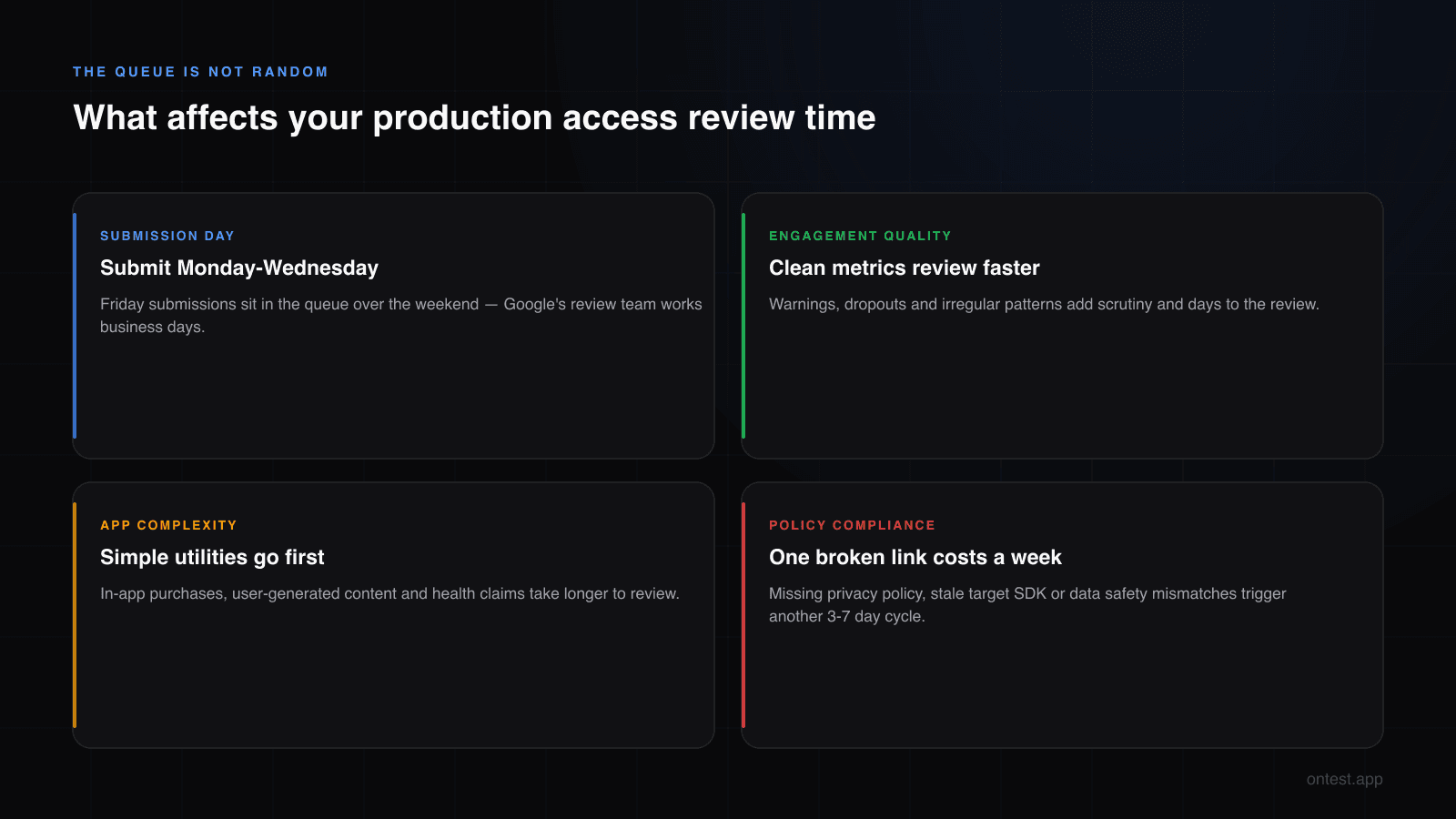
Submission day matters. If you submit on a Friday, your review sits in the queue over the weekend. Google's review team operates on business days. I saw zero movement on weekends for both of my apps. Submit Monday through Wednesday for the fastest turnaround.
Tester engagement quality matters. Clean, consistent 14-day engagement with no warnings = faster review. Warnings, tester dropouts, or irregular patterns = additional scrutiny and longer review times.
App content complexity matters. A simple utility app (like mine) gets reviewed faster than an app with in-app purchases, user-generated content, or health claims. Motion Cues technically makes health-adjacent claims (motion sickness prevention), but I'd documented the science clearly in the store listing, which I think helped.
Policy compliance matters. Missing privacy policy, incorrect target SDK, incomplete data safety section — any of these can trigger rejection, adding another 3-7 day cycle. If you want to avoid the most common pitfalls, I wrote a guide on how to answer the production access questionnaire correctly — and if you've already been rejected, here are the 5 real reasons and the recovery plan.
2026-Specific Review Observations
Google Play app review time in 2026 has been relatively consistent at 3-7 business days for production access reviews. I haven't seen evidence of major delays like some developers reported in late 2024.
However, there's a pattern worth noting: review times spike after Google I/O and major policy updates. When Google announces new Play Store policies (which happened at I/O 2025), there's typically a 2-3 week period where review times stretch to 7-10 days as the review team adjusts to new guidelines. If you're submitting during one of these windows, budget extra time.
The Real Total: Phase-by-Phase Math
Here's what the full Google Play closed testing review time looks like in 2026, broken into three scenarios:
If You Have Testers Ready (Best Case)
| Phase | Duration |
|---|---|
| Internal testing setup | 1 day |
| Finding 12 testers | 0 days (already have them) |
| Opt-in + engagement start | 1 day |
| 14-day testing window | 14 days |
| Production access application | Same day |
| Google review | 3-5 business days |
| Total | ~19-21 days |
DIY with Reddit, Friends, Family
| Phase | Duration |
|---|---|
| Internal testing setup | 1-2 days |
| Finding 12 testers | 3-8 weeks |
| Opt-in wait | 2-5 days |
| 14-day testing (with buffer) | 14-17 days |
| Production access application | Same day |
| Google review | 5-7 business days |
| Total | 45-90 days |
My Actual Timelines
| Motion Cues | Let it Rain | |
|---|---|---|
| Setup started | Late Dec 2024 | Feb 2025 |
| Released on Play Store | March 11, 2025 | May 22, 2025 |
| Total time | ~3 months | ~2.5 months |
| Biggest time sink | Finding reliable testers | Replacing inactive testers |
How to Speed Up Each Phase (Genuine Tips)
Phase 1 — Setup: Have your privacy policy, screenshots, and store listing ready before you upload. Pre-write your app description. Don't iterate in Play Console — prepare everything externally first.
Phase 2 — Finding testers: Start recruiting before your code is 100% done. Target 15-18 people, not 12. The buffer absorbs inevitable dropoffs. Skip Fiverr — the success rate is near zero in 2026, and Google's detection is better than ever.
Phase 3 — The 14 days: Stay in touch with testers daily. A simple "thanks for opening the app today" keeps people engaged. Don't push app updates during the final 5 days — testers need to install the update, and half will forget, creating an activity gap.
Phase 4 — Production review: Submit Monday through Wednesday. Make sure your data safety section, privacy policy, and target SDK are all current. Fill out the production access questionnaire thoroughly — vague answers invite follow-up questions and delays.
What I'd Do Differently Now
If I were launching a third app today, I wouldn't spend a single day hunting for testers. Not because the DIY route is impossible — I did it twice — but because the time cost is absurd relative to the alternative.
I built onTest specifically because of this experience. Twelve real Android testers on real devices — Samsung Galaxy S24 Ultra, Xiaomi Redmi 15C, Nothing Phone 2, and others — opt in within hours of ordering. The 15-day testing window (the 14 Google requires plus 1 bonus day) starts immediately with daily engagement tracked on a live dashboard. For a flat $19.99, the entire Phase 2 that cost me 6 weeks on Motion Cues takes a few hours to set up.
But even if you don't use onTest — whether you find testers through friends, Discord communities, or any other method — the key insight is the same: Phase 2 is the variable. Everything else is fixed. Solve Phase 2 fast, and your total Google Play closed testing review time in 2026 drops from 3 months to 3 weeks.
Related guides
- Google Play's 12 Testers 14 Days Requirement Explained — The rule behind the timeline: who it applies to and how the clock works.
- How to Get 12 Testers: 7 Methods Compared — Solving Phase 2, the variable that decides everything.
- Closed Testing Rejected? 5 Reasons Why — The recovery plan when the review comes back negative.
- Production Access Questionnaire: 10 Questions Answered — Templates for the form at the end of Phase 4.
- Why Real Human Testers on Real Devices Matter — Why engagement quality changes your review time.
Questions about the timeline or the process? I've been through it twice and I'm happy to help — reach out at hello@ontest.app.
Ready to ship your Android app?
Get 12 real testers for Google Play Closed Testing in 14 days.
Get Started