Free Testers vs Paid Testers for Google Play Closed Testing: What Free Actually Costs (2026)
I run a free tester swap community on Reddit and I also sell paid testing. Here is the honest comparison from someone sitting on both sides: what free tester exchanges really cost you in hours, when they work, when they quietly ruin your launch, and when paying $19.99 is the cheaper option.
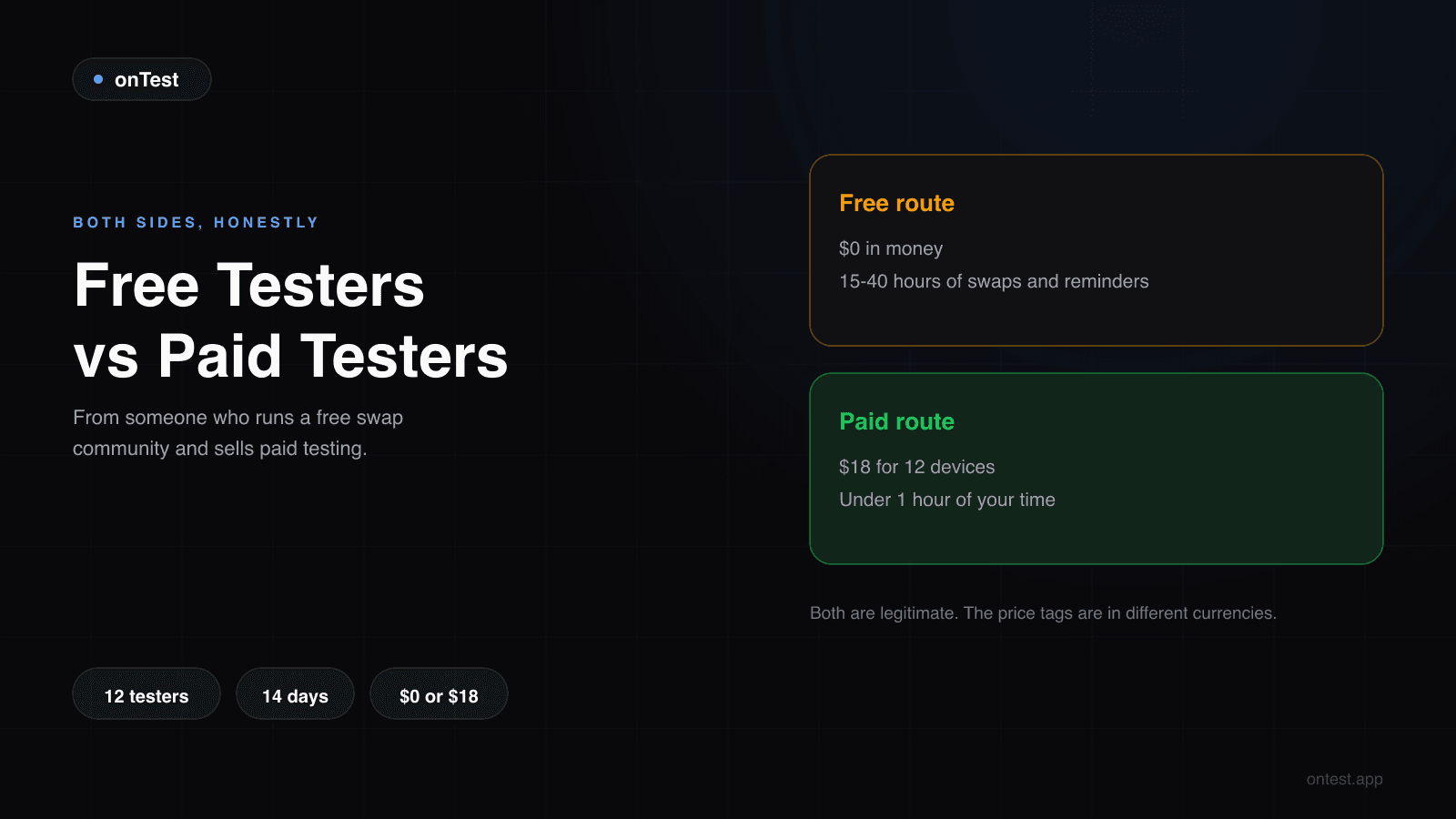
TL;DR: You can absolutely pass the 12 testers, 14 days requirement without paying anyone. Tester exchanges, Reddit swap threads, Discord groups and your own circle all work, and I say that as someone who moderates a swap community on Reddit. What nobody puts on the landing page is the price tag in hours: testing three strangers' apps to earn credits, opening 12 swap partners' apps daily for two weeks, chasing dropouts on day 9. Free is real, but it costs 15 to 40 hours and carries a higher rejection risk. Paid is $19.99 and costs about 20 minutes. This post lays out both sides with actual numbers so you can pick based on your situation, not on a landing page promise.
Here is my conflict of interest, stated upfront: I built onTest, a paid testing service. I also run r/GooglePlayClosedTest, a subreddit where developers swap tests with each other for free, and I spend time in there most days helping people match up.
So I profit when you pay, and I volunteer my evenings so you don't have to. Make of that what you will. The useful part is that I see hundreds of free swaps and hundreds of paid orders from the inside, and the patterns are very consistent. That is what this post is about.
The Free Options, and What Each One Really Asks of You
"Free testers" is not one thing. There are four distinct routes, and they fail in different ways.
Credit-based tester exchanges
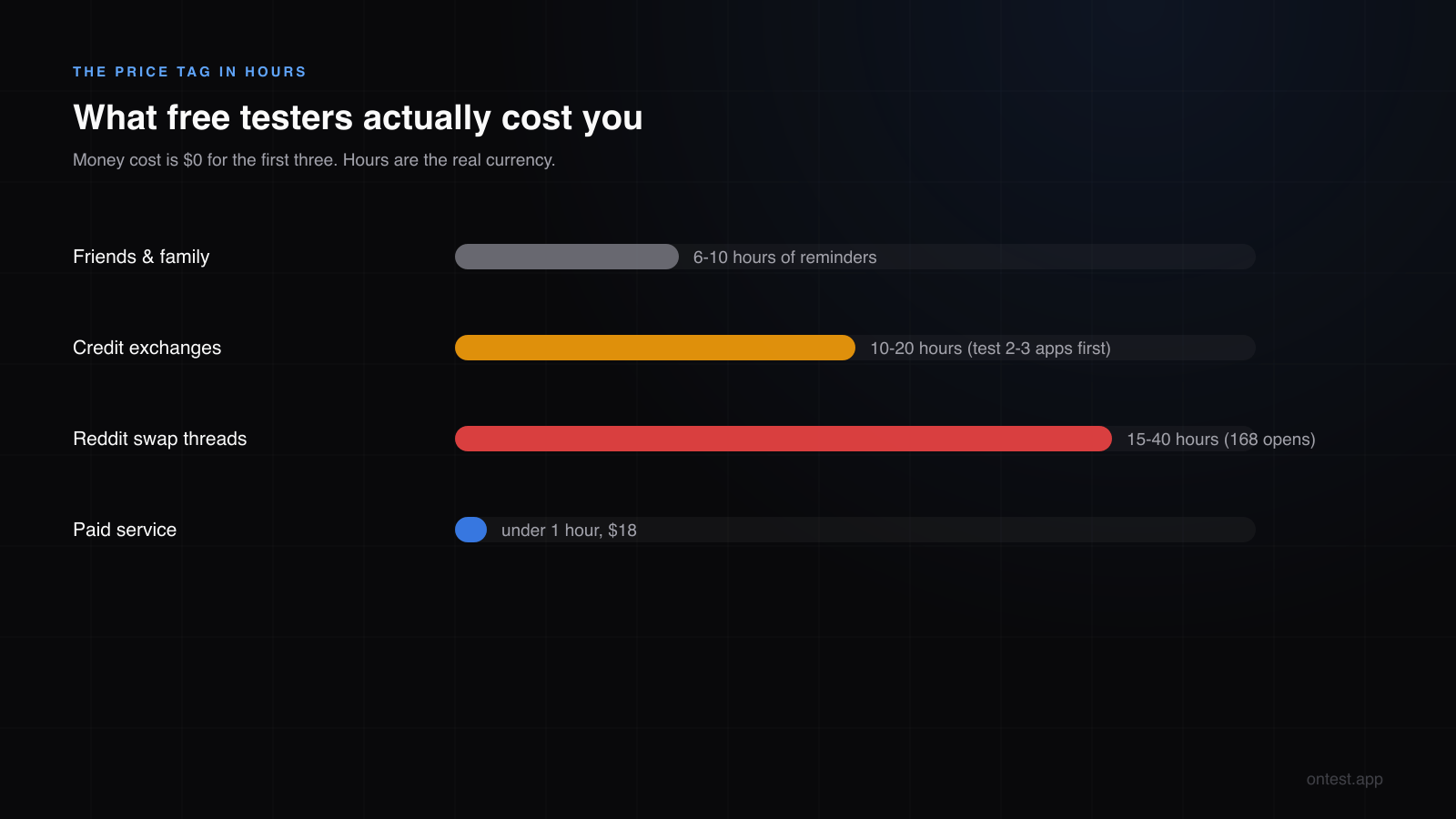
Several platforms formalize swapping: you install and test other developers' apps to earn credits, then spend credits to get testers on your app. The mechanics vary, but a typical entry fee is testing 2-3 apps before you can list your own.
The part that surprises people: earning enough credits usually means committing to those apps for their full 14-day windows too. You are not tapping a button three times. You are adding two or three daily habits to your life for two weeks before your own test even starts.
Quality is the other issue. Exchange testers are there for credits, not for your app. Sessions are short, feedback is rare, and when their credit goal is met, engagement drops off. Some exchanges police this well. Others are full of accounts that would not survive Google's device and engagement checks.
Reddit swap threads
This is the route I know best, since I moderate one of these communities. You post your app, someone posts theirs, you agree to test each other for 14 days.
The math deserves to be written out. Twelve testers means twelve swap agreements. Each agreement obliges you to open someone else's app every day for 14 days. That is 168 app-opens of other people's work, spread across two weeks, as the entry fee for launching yours.
And swaps are fragile in a specific way: they collapse in chains. Your partner drops out, so you stop testing their app, so their other partners get suspicious, and three people's tests wobble at once. I watch this happen in my own community weekly, and there is only so much a moderator can do about it. The regulars who succeed treat swapping like a part-time job, with spreadsheets.
Discord and Telegram groups
Faster communication than Reddit, same underlying economics. The good servers have reputation systems, which helps. The bad ones are full of people who collect their 12 testers and vanish without honoring their side. You cannot tell which kind of server you joined until a week has passed, and that week comes out of your launch schedule.
Friends and family
The only free route where people genuinely care about you, which is worth something. The problem is that caring about you and opening your app daily for 14 days are different commitments. My own numbers from Motion Cues: a developer group of 40 friends produced 3 Android users, and family testers mostly forgot by day 3. The full story is in the founder post, but the short version is that my personal network covered 5 of the 12 slots, and keeping those 5 active was a daily reminder campaign.
The Line Nobody Reads on the Free Tester Landing Pages
Every free option shares one structural weakness, and it has nothing to do with the platforms being dishonest.
Free testers have no reason to stay engaged after their own goal is met.
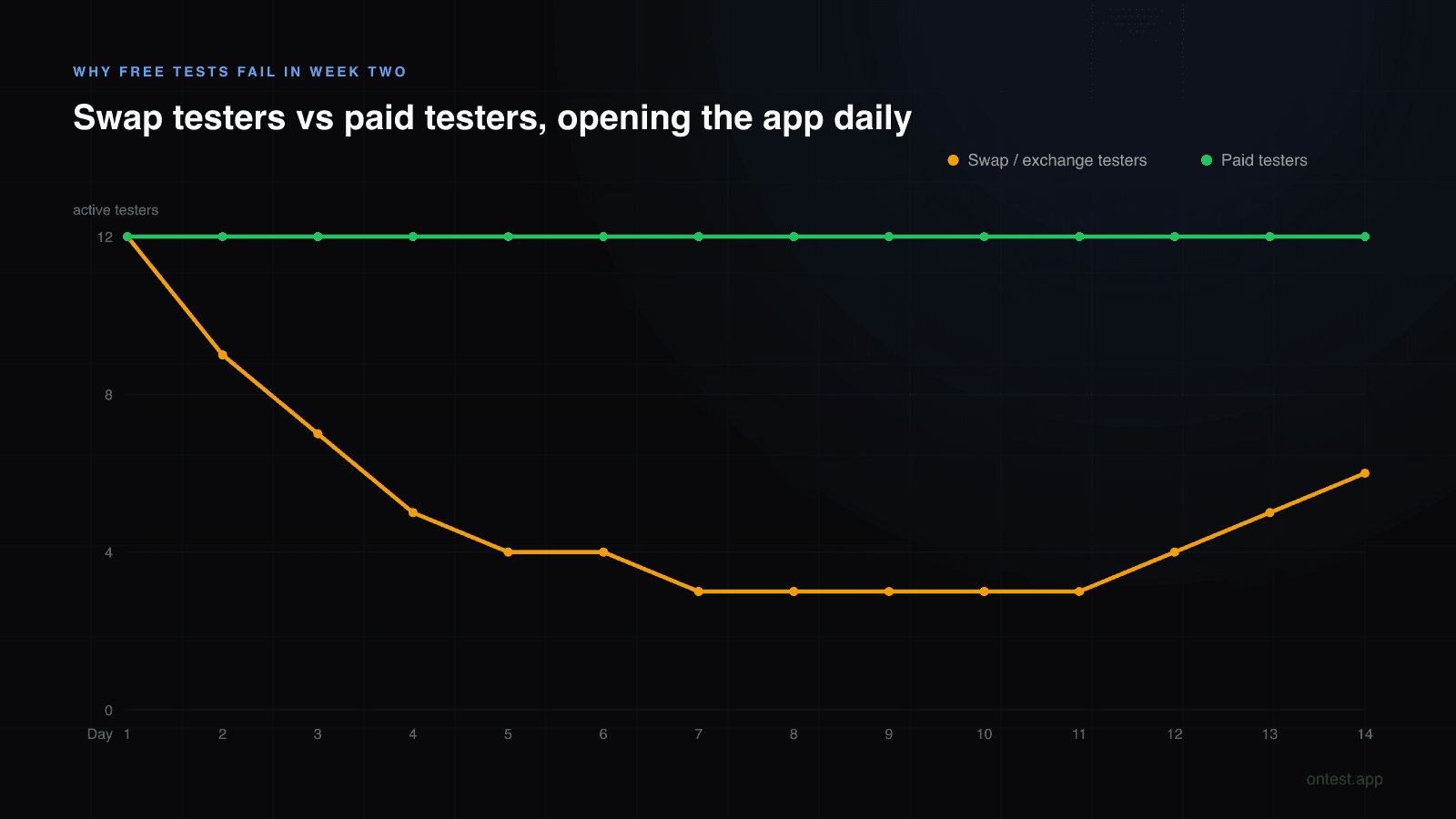
A swap partner's incentive lasts exactly as long as you are testing their app. A credit farmer's incentive ends when the credits land. A cousin's incentive was never strong to begin with. None of this matters on day 1, when everyone opts in and your Console shows 12. It matters on day 6, when the number Google actually evaluates, daily engagement, has quietly dropped to 4 while your opted-in count still reads 12.
That gap is the single most common reason free-route tests end with "we need you to continue testing your app with real testers". Not fraud. Not emulators. Just twelve people whose motivation ran out before day 14 did.
What You Are Actually Buying When You Pay
A paid service is not buying testers. Opt-ins are cheap, as every Fiverr victim learns. What you are paying for is the part free routes cannot promise:
Engagement that lasts 14 days. onTest testers are compensated for daily usage, not for opting in. Their incentive expires on day 14, the same day yours does. That alignment is the whole product.
Replacements without drama. When a device drops, another joins. No renegotiating a swap, no begging in a group chat.
Devices that pass inspection. Real consumer hardware on Android 14+, named models you can see, no rooted phones or emulators sneaking into your pool the way they sometimes do through anonymous exchanges.
Proof. Daily screenshots from every device, so "are they actually testing" stops being a feeling and becomes something you can check.
The price for that at onTest: one flat package. Twelve testers, 15 days (the 14 Google requires plus 1 bonus day), $19.99, with a 3-day money-back guarantee. Roughly the cost of a pizza, against 15-40 hours of swap labor. (The detailed comparison against other paid services is a separate post; this one is about free vs paid as categories.)
To be fair to the other side: paying does not remove your own homework. Your store listing, privacy policy and data safety form still need to be right, and no honest service claims to control Google's decision. What a good service removes is testing itself as the failure point.
Free vs Paid, Side by Side
| Free (swaps, exchanges, friends) | Paid (real-device service) | |
|---|---|---|
| Money | $0 | $15-30 |
| Your hours | 15-40 over two weeks | Under 1 |
| Time to 12 opt-ins | Days to weeks | Hours |
| Engagement through day 14 | Decays, needs your policing | Contractual, monitored |
| Dropout handling | Your problem, chain reactions | Automatic replacement |
| Device quality | Unknown, occasionally emulators | Verified, Android 14+, visible models |
| Rejection risk | Medium to high | Low |
| Best for | Zero budget, flexible timeline | Deadlines, second attempts, sanity |
When Free Is Genuinely the Right Call
I run a free swap community, so believe me when I say free works in specific situations:
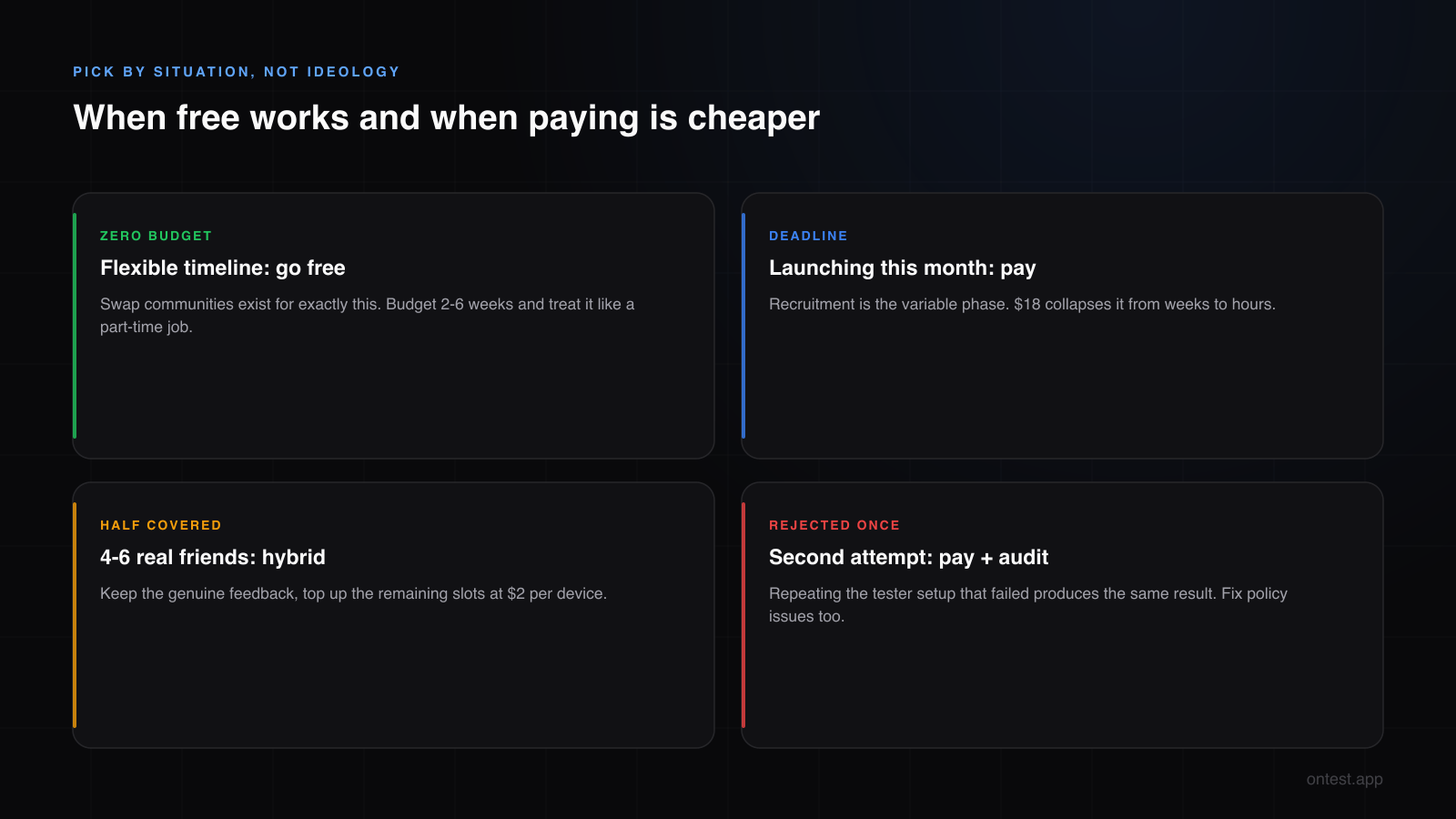
Your budget is actually zero. Not "I'd rather not spend," but zero. Students, hobbyists, developers in countries where $19.99 is a real amount of money. This is exactly who swap communities exist for, and the regulars in mine ship apps every month.
Your timeline is flexible. If launching in September instead of August costs you nothing, the 2-6 week free route is a fine trade. If you have a deadline, it is not. The full timeline math is here, but the short version is that recruitment is the phase that decides everything.
You enjoy the community part. Some developers genuinely like testing other people's apps and trading feedback. For them the 168 opens are not a cost, they are the point. No paid service replaces that.
You already have most of your 12. With 8 friends genuinely on board, filling 4 slots through swaps is manageable. Filling 12 is a different job entirely.
The Hybrid Route, Which Is What I Actually Recommend
Most developers I talk to land somewhere between the categories, and the setups that work look like this:
Friends as feedback, package as the backbone. Take the 4-6 real Android users you actually have for genuine feedback, and let a 12-device package carry the requirement itself. Your friends' opinions stay valuable, but the opt-in count and daily engagement stop depending on their consistency.
Start free, switch when week one slips. Give the swap route one honest week. If you are at 12 stable, active testers by day 7, carry on and enjoy your $0. If you are at 7 and two of them have gone quiet, stop negotiating with strangers and buy the package before your 14-day continuity window suffers for it. The mistake is not starting free. The mistake is staying free out of stubbornness three weeks past the point where the hours stopped being worth it.
Over-recruit regardless of route. Free or paid, target 15-16, not 12. Buffers absorb the dropouts that both routes produce. This is the same advice from the recruitment guide, and it has survived every launch I have watched.
Frequently Asked Questions
Are free tester exchanges allowed by Google?
Yes. Google cares that your testers are real people on real devices who genuinely use the app, not how you found them. Swaps, exchanges, communities and paid services are all legitimate channels, and the production access questionnaire treats them the same way.
How long does it take to get 12 free testers?
Through exchanges and swap threads, typically 1-4 weeks to reach 12 opt-ins, and the harder part is keeping 12 genuinely active through the full 14 days. Through a paid service, opt-ins land within hours. The gap is not in finding people, it is in sustained engagement.
Do tester exchange credits expire or carry over between apps?
Depends on the platform, but the bigger catch is that each new app needs its own fresh 12-tester, 14-day test, so a second launch means earning credits all over again. Swap relationships, on the other hand, do carry over: developers who stay active in communities find their second launch much easier.
Why do free swap tests get rejected more often?
Because engagement decays. Swap partners open your app begrudgingly and briefly, credit farmers stop at their goal, and by week two the daily-active count is far below the opted-in count. Google evaluates the engagement, not the opt-in list, so the test fails the review even though Console showed 12 throughout.
Is $19.99 for testers worth it if I have no deadline?
If your time is worth more than roughly $1 per hour to you, yes, since the free route costs 15-40 hours. If budget is genuinely zero, the free route works and thousands of developers ship through it. Both answers are legitimate; pick the one that matches your actual constraints.
Can I mix free testers and paid testers in one closed test?
Yes, and it is often the best setup. Google sees one tester list; it does not care that 5 came from your WhatsApp group and 7 from a service. Keep the total at 15+ so a dropout from either group never takes you below 12.
What should I check before joining a tester exchange?
Whether the community is active this month (dead servers cost you a week to detect), whether there is a reputation or tracking system, and what happens when a partner drops out. Ask how disputes are handled. If nobody can answer, expect to be your own enforcement department.
Do friends and family count as real testers for Google Play?
Fully. Any real person with a real Android device and Google account counts. The risk with personal-network testers is not legitimacy, it is engagement: they forget. If you go this route, send one short daily reminder and replace anyone who goes silent for two days.
Related guides
- How to Get 12 Testers: 7 Methods Compared covers every channel in detail, including the ones this post grouped together.
- What Counts as an "Active" Tester? explains the opt-in vs engagement gap that decides free-route tests.
- Google Play's 12 Testers 14 Days Requirement Explained is the rule both routes exist to satisfy.
- Closed Testing Rejected? 5 Reasons Why is where to go if a free-route test already came back rejected.
- Why Real Human Testers on Real Devices Matter covers the device and engagement signals Google checks either way.
- How to Set Up Google Play Closed Testing: Step-by-Step if you have testers lined up but the track is not built yet.
Weighing the two routes for your specific situation? Email me at hello@ontest.app and tell me your budget and deadline. I will give you a straight answer, and sometimes that answer is "use the free subreddit, here is the link."
Ready to ship your Android app?
Get 12 real testers for Google Play Closed Testing in 14 days.
Get Started