Personal vs Organization Google Play Account: Who Actually Needs 12 Testers for 14 Days? (2026)
Organization accounts skip Google Play closed testing entirely. Personal accounts created after November 13, 2023 do not. Before you rush to register a company and a D-U-N-S number, here is the honest math on both paths: verification timelines, transfer traps, and why running the 14-day test is usually faster than escaping it.
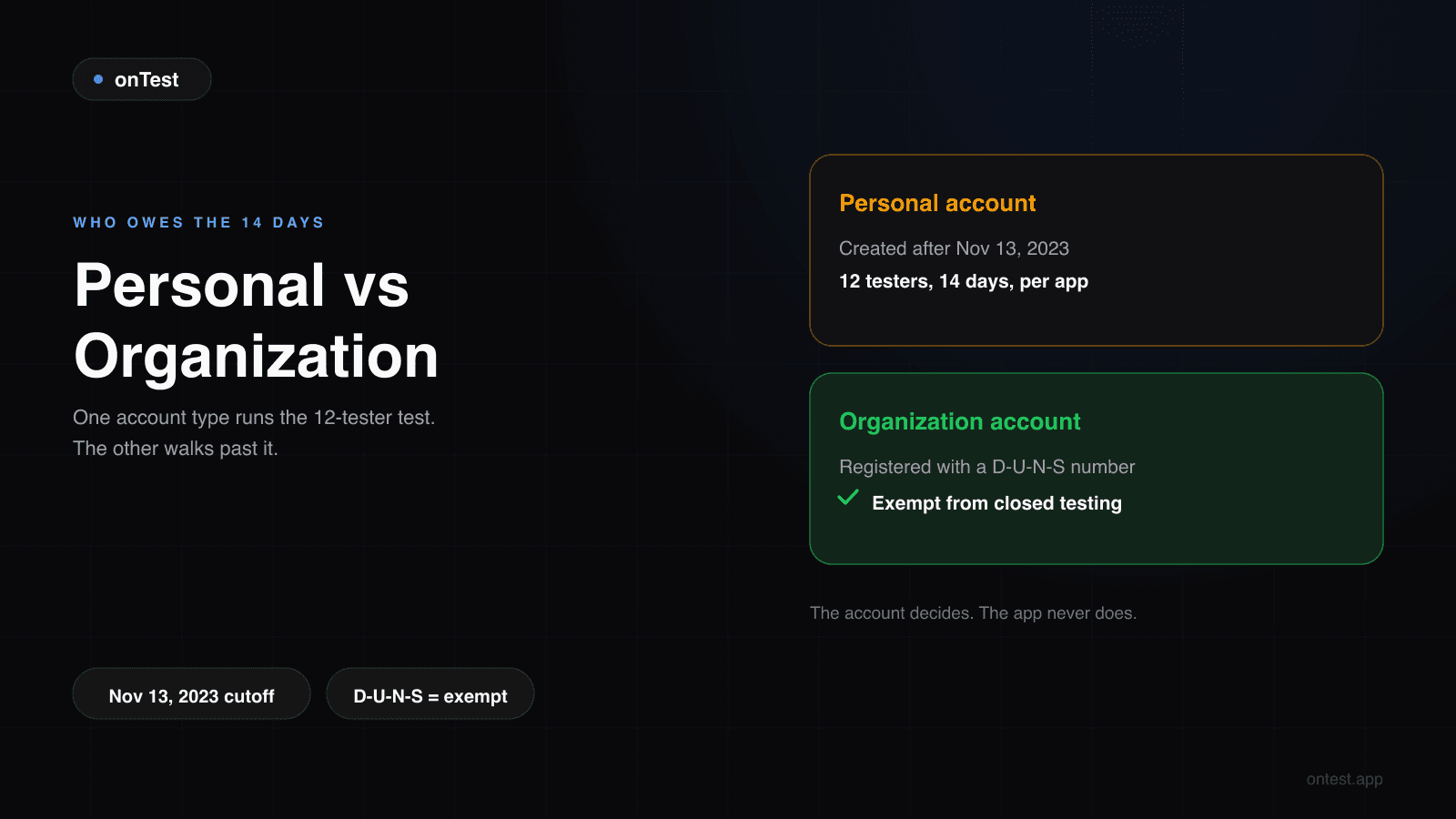
TL;DR: Whether you owe Google the 12 testers, 14 days closed test comes down to two questions: is your developer account personal or organization, and when was it created. Organization accounts (registered with a D-U-N-S number) are fully exempt. Personal accounts created after November 13, 2023 must run the test for every new app. That exemption tempts a lot of solo developers into the "I'll just register a company" plan, so I did the math: the organization route takes 4-8+ weeks of paperwork and verification, while the test itself takes 14 days plus recruitment. Unless you already have a legal entity, the wall is usually faster to climb than to walk around.
Every week someone emails me a variation of the same question: "If I convert to an organization account, can I skip the 12 testers thing?"
The answer is yes, technically. Organization accounts do not run closed tests. And almost every time I walk the person through what "converting" actually involves, they end up just running the test. This post is that walkthrough, written down so I can stop retyping it.
The Two Questions That Decide Everything
Google's requirement applies based on your account, not your app. A meditation app and a banking app on the same account face the same rule. So the entire matrix is:
Question 1: When was the account created? Before November 13, 2023: exempt, grandfathered, nothing to do. On or after that date: continue to question 2.
Question 2: Personal or organization? Organization (registered with a D-U-N-S number as a legal entity): exempt. Personal: you run a closed test with 12 testers for 14 consecutive days before every new app can apply for production access.
That is the whole thing. No exemption for app category, no exemption for "it's just a simple utility," no exemption because your app serves a nonprofit or a government agency. I have seen all three assumed on forums, and all three are wrong. The account type decides, nothing else.
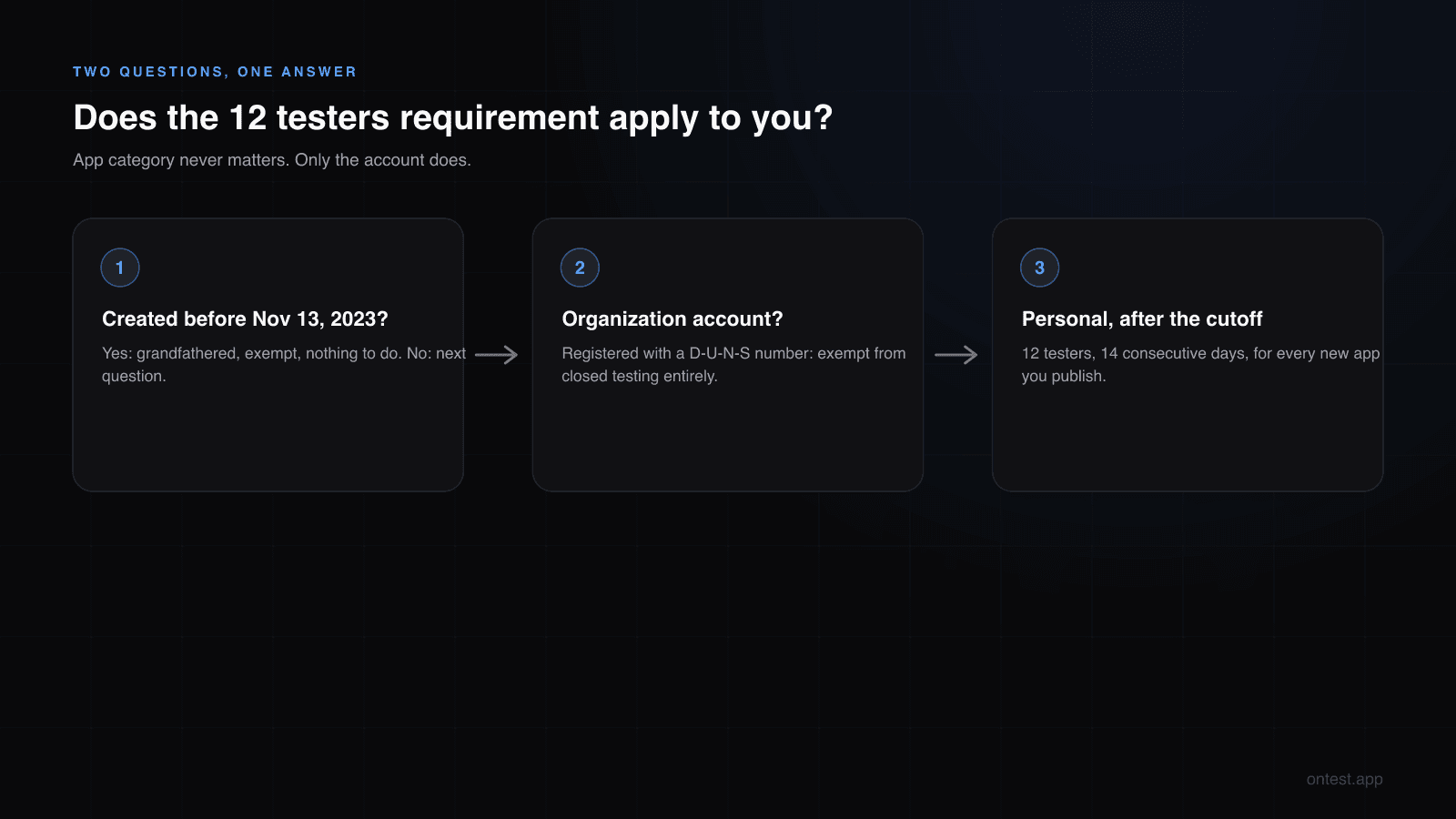
One nuance worth knowing because it surprises people later: the requirement is per app, not once per account. A personal account under the rule runs a fresh test for every new app it publishes. I learned this on my second app, when I assumed my first app's testers would carry over. They do not.
What an Organization Account Actually Requires
The exemption is real, and so is the paperwork behind it. Here is the path for a solo developer starting from zero:
1. A legal entity. Sole proprietorship, LLC, limited company, whatever your country offers. If you have one already, skip ahead. If not, this is its own project with its own costs and, depending on where you live, its own tax consequences that outlast your app launch.
2. A D-U-N-S number. Dun & Bradstreet's business identifier. It is free to request, and the standard issuance can take up to 30 days. Your business details (legal name, address, phone) must match your registration documents exactly, because Google checks them against each other.
3. A new organization Play Console account. The same $25 one-time fee, plus organization details, plus a verified business website and contact information in some flows.
4. Google's verification. Google confirms the D-U-N-S data, the legal entity, and your authority to represent it. Budget 1-3 weeks, longer if any detail mismatches and you enter the correction loop.
5. App transfer, if you already published under a personal account. Transfers between accounts are supported but reviewed, and they add days.
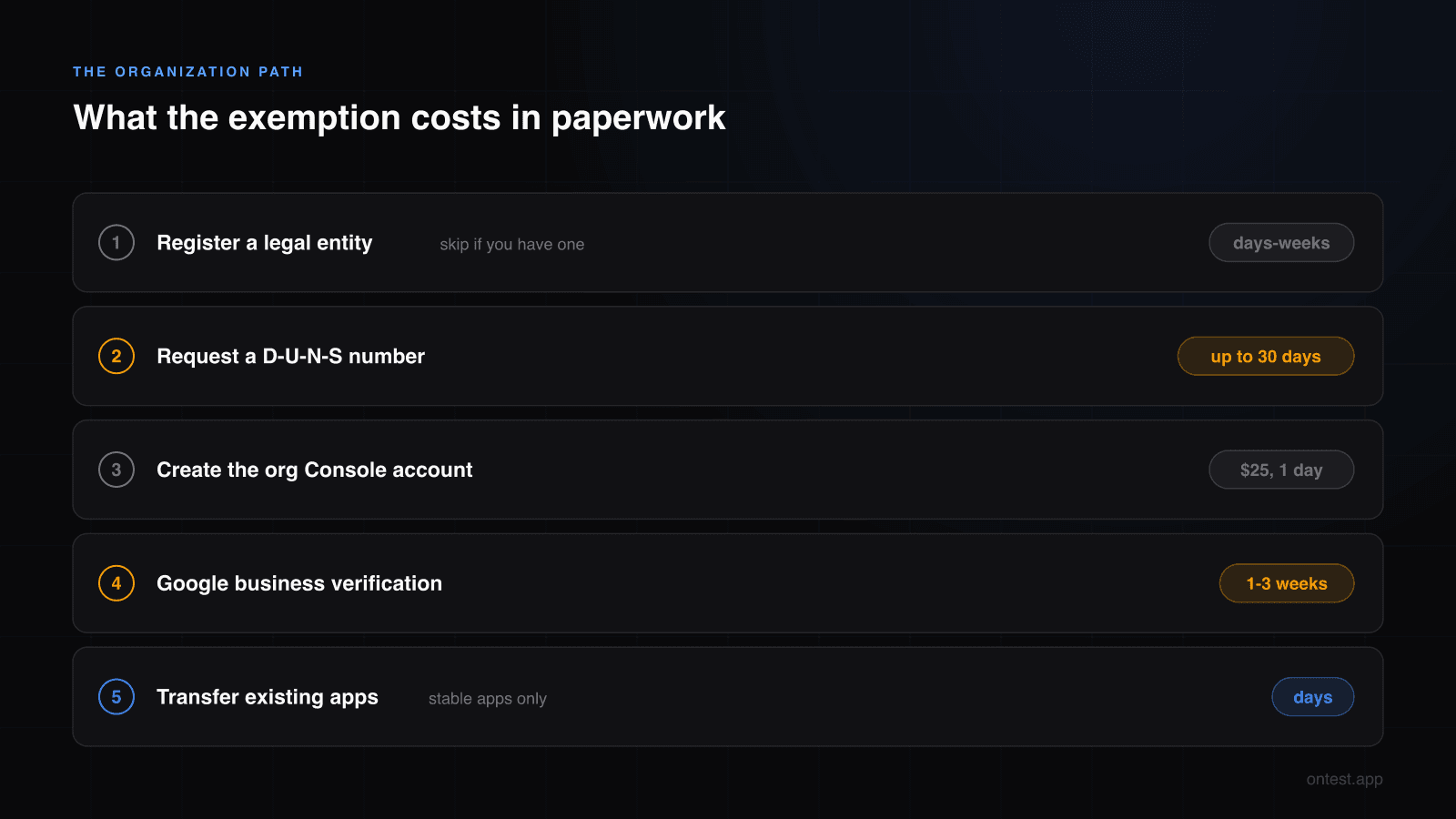
Add it up and the realistic best case for someone starting without a company is around 4-8 weeks, with real money spent on entity registration in many countries. The worst cases I have heard about were stuck in verification loops for two months over an address formatting mismatch.
The Math, Side by Side
Here is the comparison I actually draw for people who email me:
The organization route: 4-8+ weeks, company registration costs, D-U-N-S wait, verification risk, and a legal entity you now maintain forever, including the years after you lose interest in this app.
The closed test route: setup takes 1-2 hours, recruitment takes hours with a paid service or 2-6 weeks DIY, the test itself takes 14-17 days, and Google's review takes 3-7 business days. With testers ready, the whole thing lands at 18-22 days end to end. Cost: $19.99 if you buy the testers, $0 plus your time if you go the free route.
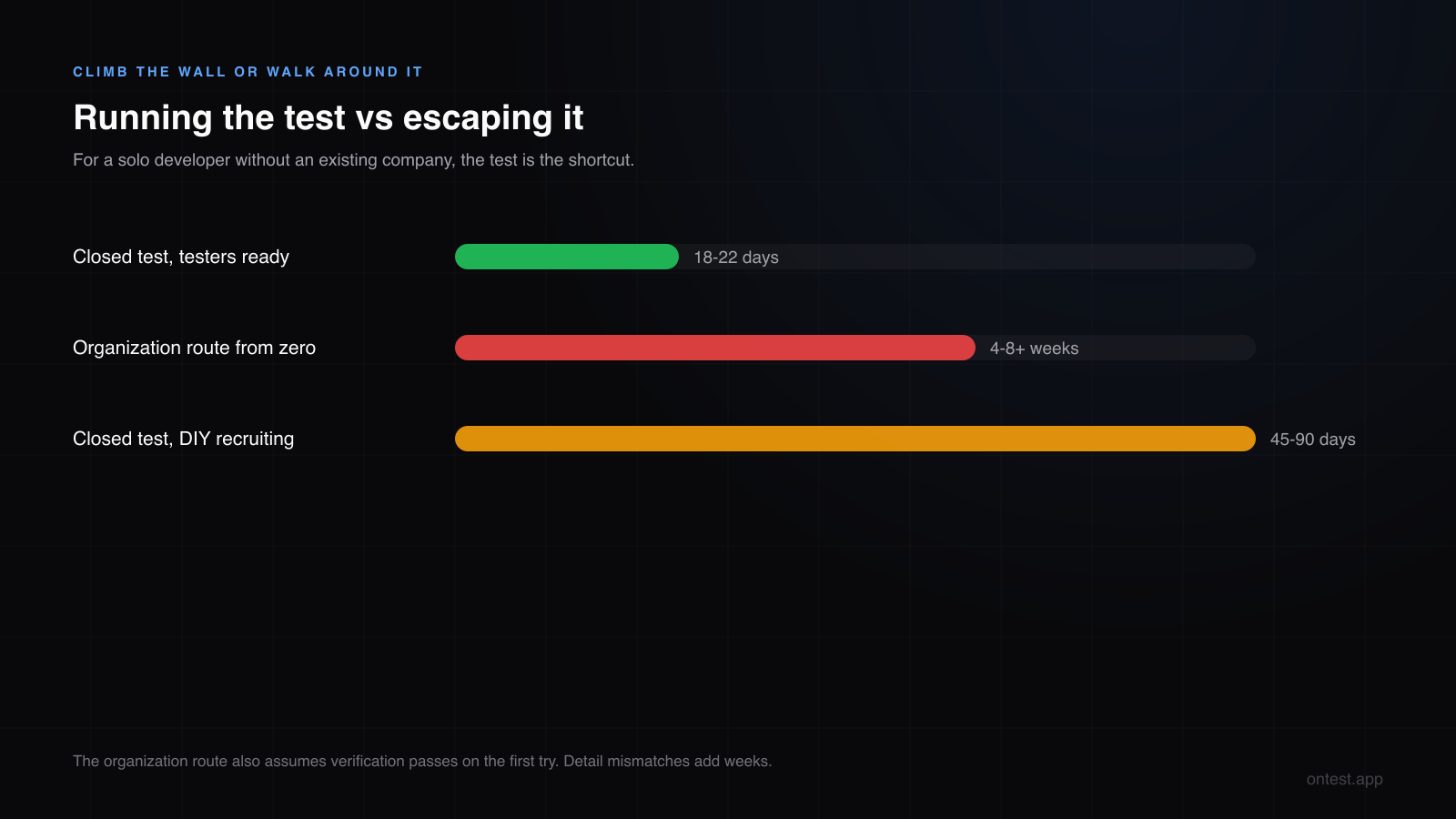
For a solo developer with one app and no existing company, the test wins on every axis: faster, cheaper, and it leaves nothing behind to maintain. The people who tell you "just get an org account" on Reddit usually already had a company, which changes the math completely.
When the Organization Account Is the Right Answer
The exemption exists for a reason, and for some developers it is clearly the better path:
You already have a registered company. Then most of the cost is sunk. Getting the D-U-N-S number and passing verification still takes weeks, but if you are not launching this month, it removes closed testing from every future launch.
You ship apps regularly. The test is per app. If your pipeline is four apps a year, that is four recruitment rounds and four 14-day windows annually. An organization account amortizes its setup pain very quickly at that rate.
Clients or an agency setup. If you publish for clients, an organization account is the correct structure regardless of the testing rule, and the exemption comes along for free.
A grandfathered personal account is not for sale, by the way. Every few weeks someone asks about buying a pre-2023 account. Account trading violates Google's terms and bought accounts have a way of getting banned right after your app starts earning. Do not.
The Conversion Trap Nobody Warns You About
The word "convert" is misleading. You do not flip a switch on your existing personal account. You create a separate organization account and transfer your apps to it. That distinction produces two traps:
The mid-launch trap. If your app is sitting in closed testing right now and you start the organization process today, you are pausing a 3-week problem to start an 8-week one. The forums are full of threads asking Google for a waiver in exactly this position, and the answer is always the same: no waiver, the requirement follows the account type, finish one path or the other. If you are mid-launch, finish the test. Recruiting the 12 testers is a solved problem in a way that expedited D-U-N-S verification is not.
The half-transfer trap. Some developers create the org account, get verified, and then discover their pending app cannot simply hop over mid-review, or that a transfer resets progress they thought they had banked. Details shift with Play Console updates, so I will not pretend to document every case, but the pattern is stable: transfers are for stable, published apps, not for apps stuck halfway through a launch.
If You Are Staying Personal
That is most people reading this, and the requirement is genuinely manageable once you treat it as a checklist instead of a wall:
- Set up the closed testing track properly, including the country-selection step everyone misses.
- Recruit 15-16 testers, not 12, through whichever channel fits your budget.
- Keep them genuinely active, meaning daily opens, for the full 14 days.
- Answer the production access questionnaire with real numbers, not pleasantries.
If the recruitment step is the part you dread, that is the part onTest sells: 12 real testers on premium Android devices, opted in within hours, active daily for the full window. One flat package: twelve testers, 15 days, $19.99, which is less than most company registration fees by two orders of magnitude.
Frequently Asked Questions
Do organization accounts need 12 testers for closed testing?
No. Organization developer accounts, registered with a D-U-N-S number as a legal entity, are exempt from the closed testing requirement entirely and can apply for production access without the 14-day test.
Does the 12 testers rule apply to old personal accounts?
Personal accounts created before November 13, 2023 are grandfathered and exempt. The requirement applies only to personal accounts created on or after that date, and your own Play Console shows which case applies to you.
Can I convert my personal Google Play account to an organization account?
Not directly. You create a new organization account, complete D-U-N-S and business verification, and transfer your apps to it. The process typically takes several weeks and requires a registered legal entity whose details match your D-U-N-S record.
How long does it take to get a D-U-N-S number?
Requesting one from Dun & Bradstreet is free and standard issuance can take up to 30 days. Google then verifies the number and your business details during account setup, which adds more time if anything mismatches.
Is registering a company just to skip closed testing worth it?
Rarely. For a solo developer without an existing entity, the organization path costs 4-8+ weeks and real registration fees, while the closed test takes 14-17 days plus recruitment and can be completed for $19.99. The organization route makes sense if you already have a company or ship many apps per year.
Are nonprofit or government apps exempt from the 12 testers requirement?
No. There is no exemption based on what the app does or who it serves. Only the account type and creation date matter. A nonprofit publishing from a new personal account runs the same test as everyone else.
If I transfer my app to an organization account, does the closed testing requirement disappear?
For apps published under the org account, the requirement does not apply. But transfers mid-launch are messy: an app stuck in closed testing does not simply carry its progress across, and the transfer itself takes review time. Finish the test first if you are already in it.
Can I buy an old personal account that is exempt?
Account trading violates Google Play's terms, and purchased accounts are a common source of bans, often after the app has started earning. Run the test or build the organization account properly.
Related guides
- Android Developer Verification Is Live explains the new identity and package registration check every account type now passes, and why it is separate from the 14 days.
- Google Play's 12 Testers 14 Days Requirement Explained covers every clause of the rule this post's matrix comes from.
- How to Set Up Google Play Closed Testing: Step-by-Step is where to start if you are staying personal.
- Free Testers vs Paid Testers compares the two ways to fill your 12 slots.
- How Long Does Google Play Closed Testing Actually Take? has the full timeline the 18-22 day figure comes from.
- What Counts as an "Active" Tester? explains what your 12 testers actually have to do during the 14 days.
- Production Access Questionnaire: 10 Questions Answered is the form waiting at the end of either path.
Not sure which side of the matrix your account falls on? Email a screenshot of your Play Console dashboard to hello@ontest.app and I will tell you exactly what applies to you and what I would do next.
Ready to ship your Android app?
Get 12 real testers for Google Play Closed Testing in 14 days.
Get Started